Key Takeaways
1. The Conflict: Scientism vs. Spirituality
The view that all mental processes are necessarily physical processes is a metaphysical assumption, not a scientific fact.
Modern dilemma. Many individuals yearn for spiritual meaning, yet modern scientism—a rigid, dogmatic materialism—dismisses such pursuits as irrational or delusional. This creates a profound internal conflict, forcing people to choose between their spiritual inclinations and the perceived authority of science. The author's "Western Creed" exercise vividly illustrates how deeply ingrained materialistic beliefs can be, even for those who consciously identify as spiritual seekers.
Unconscious bias. This conflict is often exacerbated by unconscious biases, where our perceptions are shaped by deeply held beliefs without our awareness. If one unconsciously believes in a purely material universe, they will automatically interpret events to validate this view, reinforcing the dismissal of anything spiritual. This "believing is seeing" phenomenon can lead to self-sabotage in spiritual exploration, as genuine experiences are invalidated by an internalized materialistic worldview.
The cost of denial. The widespread denial of spirituality, fueled by scientism, can lead to a sense of meaninglessness and a focus on transient material gratification. Bertrand Russell's stark assertion that human life is merely an "outcome of accidental collocations of atoms" and destined for "extinction" exemplifies this nihilistic perspective. Such a worldview, when deeply internalized, can foster depression, cynicism, and a lack of long-term vision, impacting both individual well-being and societal values.
2. Essential Science: A Path to Deeper Knowing
Essential science and common sense keep coming back to data, fact, and observation.
Beyond dogma. True science, or "essential science," is a humble, open-ended process of knowledge refinement, distinct from rigid "scientism." It combines four ways of knowing:
- Experience: Learning from direct observation and experimentation.
- Authority: Consulting experts, but critically evaluating their claims.
- Reason: Logical thought and theory building.
- Revelation: Insights from altered states of consciousness, treated as data.
Unlike scientism, essential science prioritizes empirical data over preconceived theories, constantly questioning and refining understanding.
The scientific cycle. The core of essential science involves observing reality, developing theories to explain observations, and then rigorously testing these theories through predictions about new situations. If predictions fail, theories must be revised or discarded, regardless of how elegant or emotionally satisfying they may be. This self-correcting mechanism is crucial for overcoming human biases and attachments to beliefs.
Social validation. The scientific process is strengthened by open, honest communication among peers. Researchers share their observations, theories, and predictions, allowing others to scrutinize, replicate, and extend their work. This collaborative approach helps filter out individual errors and biases, ensuring that knowledge progresses towards greater accuracy and comprehensiveness.
3. Pathologies of Cognition: Obstacles to Truth
Science, then, can be a defense. It can be primarily a safety philosophy, a security system, a complicated way of avoiding anxiety and upsetting problems.
Mind's defenses. Our minds, including those of scientists, are prone to "pathologies of cognition" that hinder genuine learning and openness to new truths. These are not just intellectual flaws but often emotional defenses against anxiety, uncertainty, or threats to our self-image. Examples include:
- Compulsive need for certainty: An inability to tolerate ambiguity.
- Premature generalization: Rushing to conclusions to feel knowledgeable.
- Denial of ignorance: Refusing to admit "I don't know" or "I was wrong."
- Inflexible need to be tough: Prioritizing an image of strength over genuine inquiry.
Pseudoskepticism's role. This defensive mindset often manifests as "pseudoskepticism," where individuals claim to be skeptics but are actually dogmatic believers in a particular system (e.g., materialism). They dismiss contradictory evidence a priori as impossible, rather than genuinely investigating it. This "debunking" serves to protect their existing worldview, often without bothering to understand the evidence they reject.
Self-knowledge is key. Recognizing these cognitive and emotional obstacles is vital for both scientific and spiritual growth. Without self-awareness, our beliefs can become "chains" that automatically distort perception and thought, trapping us in ignorance. Cultivating mindfulness and a desire for truth, even when it challenges our comfort zones, is essential for overcoming these ingrained patterns and fostering genuine understanding.
4. The "Big Five" Psi Phenomena: Evidence for a Non-Material Mind
By “demonstrated,” I mean that by the formal, rational rules of science, which have worked so well in understanding the physical world, human beings occasionally have experiences and show certain behaviors that cannot be reduced to materialistic explanations and that look like fundamental aspects of a spiritual nature.
Beyond coincidence. While spontaneous "paranormal" events like the author's "coup d'état" experience (where he inexplicably repeated a rare phrase just before receiving a letter from a "Mrs. Coudetat") are compelling, they can be dismissed as coincidence. To establish a scientific basis for a non-material mind, rigorous, controlled experiments are necessary. These experiments create conditions where, according to materialistic principles, nothing should happen, but if something does happen, it points to "paraconceptual" phenomena.
The "Big Five" categories: Decades of parapsychological research have accumulated hundreds of statistically significant experiments supporting the existence of five core psi phenomena:
- Telepathy: Mind-to-mind communication.
- Clairvoyance: Direct perception of the physical world without senses or other minds.
- Precognition: Knowledge of future unpredictable events.
- Psychokinesis (PK): Mental influence on physical objects.
- Psychic Healing: Mental influence on biological systems.
These phenomena, collectively, challenge the purely materialistic view of reality.
Nonphysical nature. A crucial aspect of these psi phenomena is their "nonphysical" nature, meaning they do not conform to known physical laws or their reasonable extensions. For instance, telepathy is not diminished by distance or physical shielding, unlike electromagnetic waves. This suggests that mind operates beyond the constraints of conventional matter, energy, space, and time, opening the door to considering a spiritual dimension of human existence.
5. Telepathy and Clairvoyance: Mind Beyond Physical Barriers
Telepathy implies, of course, that mind is somehow of a different nature than matter.
Mind-to-mind connection. Telepathy, the communication of thoughts or feelings between minds without ordinary sensory means, is a cornerstone of psi research. Experiments typically involve a "sender" focusing on target information while a "percipient," isolated from sensory cues, attempts to receive it. Results, often measured through card-guessing tests with immediate feedback, consistently show statistically significant hits beyond chance expectation, suggesting a non-physical link between minds.
Clear seeing. Clairvoyance, or "remote viewing," involves directly perceiving distant physical objects or events without sensory input or another mind's knowledge. The famous Pearce-Pratt experiment, where a divinity student accurately guessed Zener cards hidden from the experimenter, yielded odds against chance of 1 in 10^22. Later, government-sponsored remote viewing (RV) studies, like Pat Price's accurate sketch of a distant swimming pool, further demonstrated this ability, often using "blind" judges to ensure objectivity.
Beyond physical laws. Both telepathy and clairvoyance defy conventional physical explanations. They are not affected by distance or physical shielding, as demonstrated by experiments like Project Deep Quest, where a remote viewer accurately described targets from 500 feet below the ocean surface, ruling out electromagnetic radiation. This "nonphysicality" strongly suggests that mind is not merely a product of the brain but possesses capabilities that transcend known material limitations.
6. Precognition and Psychokinesis: Influencing Time and Matter
The combined results of the studies produced odds against chance of 10 septillion to 1.
Knowing the future. Precognition is the ability to predict future events that cannot be logically deduced from present information. A meta-analysis of 309 precognition studies, involving nearly two million trials, yielded astronomical odds against chance, making it "preposterous to believe that these cumulated precognition results were due to chance." This phenomenon challenges our fundamental understanding of time and causality, suggesting that some aspect of mind can access future information.
Mind over matter. Psychokinesis (PK) is the mental influence on physical objects or systems without physical contact. Early experiments involved influencing dice rolls, while modern studies often use electronic random number generators (RNGs). A meta-analysis of 148 dice experiments and 152 RNG studies showed small but statistically significant effects, with odds against chance of over a billion to one. This implies that intention alone can subtly bias physical processes, even at a quantum level.
Unconscious psi. Both precognition and PK can manifest unconsciously. The author's own lab data revealed "psi-missing" in precognition, where subjects scored below chance, implying an unconscious use of psi to avoid correct answers, perhaps to uphold a belief that psi doesn't exist. Similarly, "psi-mediated instrumental responses" (PMIRs) suggest that individuals unconsciously use psi to influence events in their favor, appearing "lucky" without conscious awareness of their psychic ability.
7. Psychic Healing: Mind's Influence on Biological Systems
So when we describe some gardeners as having a green thumb, are we recognizing a possible psychic-healing ability, or growth-stimulating ability, aside from gardening technique?
Beyond placebo. Psychic healing, the ability to positively affect biological systems through mental intention, has moved from anecdotal reports to scientifically supported phenomena. Early research by biologist Bernard Grad meticulously controlled for placebo and suggestion by using non-suggestible "patients" like wounded barley seeds and laboratory mice. These studies demonstrated significant healing effects from a healer's intention, even when the healer had no direct contact with the subjects.
Experimental evidence. Grad's mouse study involved wounding mice and assigning them to three groups: healer-treated, heat-control, and untreated control. The healer held bagged mice, visualizing healing energy, while controls received no such treatment or only hand warmth. After two weeks, the healer-treated mice showed significantly greater wound healing. Similarly, barley seeds watered with saline solution "treated" by a healer's intention grew taller and heavier than controls.
Implications for life. These findings suggest that mental intention can directly influence biological processes, supporting the idea of a non-physical, spiritual aspect of mind. The concept of a "green thumb" for gardeners or a "black thumb" for those with negative influence gains new meaning. This scientific validation encourages a serious exploration of healing modalities that transcend conventional physical and psychological explanations, opening avenues for integrating spiritual practices into health and well-being.
8. Out-of-Body & Near-Death Experiences: Direct Glimpses of a Separate Mind
You find yourself experientially located at a place other than where your physical body is, and you may or may not see your actual physical body from an outside point of view; and your consciousness feels clear during the experience.
Experiencing separation. Out-of-Body Experiences (OBEs) are profound states where consciousness feels located outside the physical body, often with vivid, "realer than real" clarity. The author's studies, including those with "Miss Z" who accurately read a hidden number from the ceiling during an OBE, provide some evidence for genuine extra-corporeal perception. However, other studies suggest OBEs can also be vivid simulations, sometimes informed by psi, or even distorted by dream-like content.
Beyond the brink. Near-Death Experiences (NDEs) occur when individuals are physiologically close to death, often involving an initial OBE, followed by an altered state of consciousness (ASC) with profound noetic knowledge. Raymond Moody's "composite case" highlights common elements like tunnel experiences, encounters with light beings, and life reviews. The remarkable consistency of NDEs across cultures and belief systems suggests an archetypal reality beyond mere hallucination.
The Pam Reynolds case. The NDE of Pam Reynolds, who underwent brain surgery requiring her body temperature to be lowered, heart stopped, and blood drained from her head (medically "dead"), offers compelling evidence. During this period of no brain activity, she reported accurate perceptions of the operating room, including details of surgical instruments and conversations, which she could not have known through normal senses. This case strongly challenges the "mind equals brain" hypothesis, suggesting consciousness can exist and perceive independently of a functioning brain.
9. Postmortem Survival: Beyond the Grave Through Mediumship and Reincarnation
After I die I won’t be surprised if I regain consciousness in some form.
The ultimate question. The possibility of postmortem survival is perhaps the most profound question in psychical research, directly challenging the materialistic view that consciousness ends with brain death. The "Big Five" psi phenomena and experiences like OBEs/NDEs provide indirect evidence, suggesting mind is more than brain, thus opening the door to survival.
After-Death Communications (ADCs). Millions report After-Death Communications (ADCs) – sensing a presence, hearing voices, feeling touches, or even visual appearances of deceased loved ones. While often dismissed as grief-induced hallucinations, these experiences are profoundly convincing to those who have them and are far more common than generally acknowledged. They offer comfort and a sense of continued connection, though scientific verification remains challenging.
Mediumship and reincarnation. Mediumship, where individuals claim to communicate with the deceased, offers more direct evidence. Cases like Eileen Garrett's accurate technical details about the R-101 dirigible crash, unknown to her, are highly evidential. However, the "super-psi" hypothesis (unconscious impersonation by the medium combined with extensive psi abilities) remains a complex alternative to genuine survival. Reincarnation, evidenced by young children spontaneously recalling past lives (e.g., William's memories of his grandfather John McConnell, including specific details and birthmarks corresponding to fatal wounds), further suggests that some aspect of identity can persist across lifetimes.
10. A Wider Model of Mind: Integrating Science and Spirituality for a Meaningful Life
I’m proud to be both a scientist and a spiritual seeker.
Beyond reductionism. The accumulated evidence from parapsychology and studies of transcendent experiences compels a shift from a purely materialistic worldview to a "wider model of mind." This model posits a "transpersonal" or "spiritual" realm, a vast intelligence and compassion that encompasses the universe, with which our individual "Mind" is intimately connected. Our ordinary "ME!" (Mind Embodied) is a bio-psychological virtual reality, a limited but crucial manifestation of this deeper nature.
Interconnected reality. Psi phenomena like telepathy and clairvoyance are glimpses of this inherent interconnectedness, suggesting that information is not bound by conventional space and time. PK and psychic healing demonstrate mind's ability to influence matter and life, further blurring the lines between the physical and non-physical. This expanded understanding of reality provides a scientific basis for spiritual longings and experiences, validating them as potentially real rather than mere delusions.
A path to progress. Integrating essential science with spirituality offers a powerful path for personal and collective growth. By rigorously investigating spiritual experiences and practices, we can move beyond dogma and superstition, developing more effective methods for spiritual development. This includes:
- Understanding the psychological factors that facilitate or inhibit spiritual contact.
- Developing "state-specific sciences" to study consciousness in altered states.
- Creating empirically validated spiritual training systems (e.g., improving meditation efficacy).
This collaborative approach can lead to a deeper understanding of human potential, fostering wisdom, compassion, and a more meaningful existence for all.
Review Summary
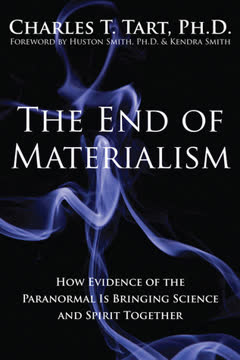
Reviews of The End of Materialism are generally positive, averaging 3.9 out of 5. Many readers praise Tart's careful distinction between genuine science and "scientism," his rigorous yet personable writing style, and the paradigm-shifting nature of his work. Positive reviewers highlight his credentials and clear explanations, calling it a "game-changer." Critics find the writing dry or academic, and some felt the book was too introductory, lacking substantial case studies or deeper exploration of paranormal research.