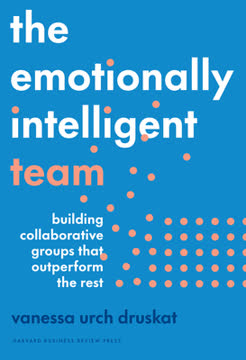
Key Takeaways
1. Individual Talent Alone Doesn't Guarantee Team Success
But, in fact, for the complex tasks conducted by work teams today, success is rarely about the individuals.
Rethink team building. Many leaders mistakenly believe that staffing a team with highly talented, individually competent people automatically leads to high performance. This "individual-first" approach, focusing on IQ, personality, or work ethic, often falls short, as evidenced by research from Google and the author's own studies. Despite intensive efforts to hire the best, teams frequently fail to deliver desired outcomes like higher productivity, innovation, and morale.
Interactions are key. The true determinant of team success lies not in individual attributes, but in the quality of interactions among members. Teams are complex systems where the patterns of how people engage, collaborate, and treat each other dictate overall effectiveness. When interactions are poor, talent is wasted, knowledge isn't shared, and members disengage, leading to "quiet quitting" or "resenteeism."
Beyond the "List." Conventional wisdom, often called "The List," includes factors like talent, skills, diversity, and work styles. While these matter, they are not strong predictors of high-level team performance. The author's research, observing hundreds of teams, consistently found that superior collaboration and performance stem from established social and emotional conditions—the team's culture and norms.
2. Team Emotional Intelligence (Team EI) is Built on Collective Norms
Team EI is a group culture created by a set of norms that build a productive social and emotional environment that leads to cooperative interactions, collaborative work processes, and hastens effective performance.
Harness human nature. Our brains are wired for social connection and cooperation, a trait that enabled human survival. This innate sociability means we instinctively develop norms—unspoken rules and expectations—to regulate interactions and increase predictability. Team EI leverages this by intentionally shaping these norms to create a productive social and emotional environment.
Norms shape behavior. A team's collection of norms, habits, routines, and rituals defines its culture. These norms, though often invisible until broken, are powerful drivers of behavior. They influence whether members experience "approach emotions" (interest, fondness, eagerness) that foster collaboration, or "avoidance emotions" (confusion, tension, aversion) that trigger self-preservation and hinder performance.
Beyond individual EI. While individual emotional intelligence is important, Team EI focuses on the group culture itself. It's about creating a collective intelligence where members' social and emotional needs are met, fostering psychological safety, trust, and belonging. This systemic approach allows teams to scale emotional intelligence across the organization, rather than building it one person at a time.
3. Cultivate Belonging and Trust by Deeply Understanding and Caring for Teammates
Team members won’t care about the team until they know how much the team cares about them.
Belonging is fundamental. The "understand team members" norm involves creating routines to learn about each other's backgrounds, abilities, priorities, and styles. This deep understanding is the first step toward fostering a sense of belonging, making members feel seen, known, and understood. This feeling is crucial because:
- It increases willingness to share ideas and challenge assumptions.
- It reduces conformity, allowing diverse perspectives to emerge.
- It improves decision integrity by leveraging collective expertise.
Caring builds connection. The "demonstrate caring" norm is an ongoing process of expressing respect, support, and encouragement. It doesn't require deep personal friendships but focuses on valuing each person's contributions. This cultivates a spirit of community and a "holding environment" that provides support during stress.
- Caring behavior increases psychological safety and trust.
- It boosts team intelligence by enhancing social sensitivity and fair turn-taking.
- It leads to higher-quality relationships, making collaboration more joyful.
Intentional practices. High-performing teams don't leave these needs to chance. They routinize self-disclosure, actively seek to understand what makes each person unique, and identify individual strengths. They also make demonstrations of respect habitual, communicate the value each member brings, and offer attention and support through relational pauses and affirmations.
4. Address Unacceptable Behavior with a Developmental, Not Punitive, Mindset
People deserve the consideration of knowing how colleagues feel about their behavior and performance, and they deserve the opportunity to respond to feedback.
Clarity and growth. The "address unacceptable behavior" norm is about collectively defining actions that harm team progress and providing constructive feedback. This isn't about punishment, but about helping members understand their impact and grow. Ignoring unacceptable behavior signals its acceptance, allowing frustration to fester and potentially leading to reduced effort from others.
Feedback as a gift. In a supportive context, most people welcome the chance to explain their behavior and learn. This norm fosters a culture of continuous development, reminding everyone that clear expectations promote trustworthy behavior and cooperation. It also offers opportunities for peer coaching, where colleagues can help each other become their best selves at work.
Strategic implementation. Successful adoption requires drawing clear lines for unacceptable behaviors and applying them consistently. Feedback should be a meaningful, two-way conversation focused on growth, not just rule enforcement. Leaders must be prepared to deliver tough feedback, understanding that initial discomfort is temporary and necessary for long-term team health and individual development.
5. Embrace Continuous Learning and Improvement Through Regular Team Reviews
Effective reviews allow people to ask questions and clarify priorities to align their views about how and why the group makes certain choices and to determine the fit between their own actions and team aspirations.
Dynamic systems need checks. Teams are dynamic systems, constantly influenced by internal and external factors. The "review the team" norm involves routine assessments of the team's effectiveness, processes, and norms. This practice, adopted by military and NASA teams, significantly improves performance by accelerating learning and adaptation.
Shared reality and control. Regular reviews build a shared mental model of the team's current situation, satisfying members' innate need to understand and control their fate. These candid sensemaking discussions clarify goals, priorities, strengths, and weaknesses, fostering a sense of belonging and inclusion. This shared understanding is a stronger predictor of team performance than cohesion alone.
Beyond problem-solving. Reviews clarify existing problems and uncover new opportunities. They prevent information withholding and premature conclusions, leading to better decisions and boosting learning and innovation. For hybrid and remote teams, reviews are crucial for maintaining clear expectations and open communication, combating psychological distance and siloed thinking. They also build team resilience, enabling quicker rebounds from setbacks.
6. Ensure Every Voice is Heard by Actively Supporting Candid Expression
In a group where true psychological safety exists, there’s usually either an explicit or an unspoken pact under which everyone agrees that airing potentially relevant information, concerns, or hunches is safer than withholding them.
Psychological safety is paramount. The "support expression" norm encourages team members to share honest thoughts and feelings, even dissenting views. This is critical because humans are wired to conform, especially when facing higher-status individuals or ambiguous data. Suppressing diverse perspectives, as seen in the Challenger and Columbia disasters, leads to poor decisions and stifles innovation.
Intrinsic motivation and learning. When psychological safety is present, members feel little social cost in being candid, admitting mistakes, or pointing out errors. This environment boosts intrinsic motivation, as contributions are sought and valued, and fosters learning and creative idea generation. Open, free-flowing knowledge exchange provides access to more views, leading to better-informed and more innovative decisions.
Flattening hierarchies and signals. To support expression, teams must actively reduce the negative effects of hierarchy and status, as exemplified by IDEO's brainstorming rules. Leaders should invite quieter members to speak up and manage talkative ones. Paying attention to nonverbal messages—healthy signals like eye contact and leaning in, versus unhealthy ones like distraction or disdain—is crucial. Embracing constructive conflict, or "creative abrasion," allows for vigorous debate that polishes ideas without devolving into personal attacks.
7. Fuel Performance and Resilience with Shared, Intentional Optimism
Stirring up positive emotions such as joy, interest, amusement, and contentment requires developing an image of future possibilities that are desirable and that we see as being under our control.
Overcoming negativity bias. Humans are naturally pessimistic, constantly scanning for threats and dwelling on negative information. This negativity bias drains cognitive resources, shrinks attention, and reduces learning. The "build optimism" norm involves routinely taking actions to foster hope and a constructive outlook, counteracting this innate tendency.
Optimism as a performance tool. Optimism, especially when shared, is a powerful motivator. It sparks positive emotions that broaden thinking, reduce fear, and increase cooperation. High expectations mobilize collective effort and stamina, driving high team performance. Research, including studies on military personnel, shows optimism predicts exemplary performance and resilience, enabling teams to rebound from errors.
Intentional cultivation. While optimism can be unrealistic, it's a useful tool for motivation. Teams must avoid "toxic positivity" that suppresses genuine concerns. Instead, they should:
- Provide feedback emphasizing progress, not just problems.
- Engage in activities like "Our Team at Its Best" or appreciative inquiry.
- Expect and provide encouragement and emotional support.
- Leverage positive emotional contagion and visualization techniques (like mental rehearsal used by athletes).
8. Proactively Anticipate and Solve Problems to Drive Innovation and Control
Proactivity is often considered an individual trait, but it can be supersized when employed by a group.
Beyond reactivity. Average teams react to problems as they emerge, but high-performing teams are proactive, managing their own destinies by anticipating and preventing issues. This "solve problems proactively" norm is crucial in turbulent environments, offering increased control over uncertainty and becoming a team's superpower.
Learning and innovation. Proactive problem-solving drives broad-view team learning, constantly seeking new and better ways of doing things. It increases creative thinking and innovation by encouraging out-of-the-box ideas and integrating diverse perspectives to foresee future challenges. This mindset extends beyond immediate tasks to new ventures and potential profitability.
Structured approach. Proactive problem-solving involves a five-phase process:
- Scouting expeditions: Routinely gather information from outside the team.
- Analyze new information: Adopt open-mindedness, critical thinking, responsibility, and a mix of optimism and pessimism.
- Make an action plan: Cocreate clear, goal-aligned plans, considering multiple scenarios (like the US Coast Guard's Project Long View).
- Act on the plan: Implement changes, presenting them as prosocial and learning-focused.
- Assess the outcome: Review results to strengthen the learning mindset and inform future proactivity.
9. Engage External Stakeholders to Gain Critical Insights and Resources
No team is an island.
Beyond internal focus. Teams are open systems, heavily influenced by external stakeholders—bosses, suppliers, customers, and collaborators. The "understand team context" and "build external relationships" norms emphasize routinely listening to and engaging with these external players. Ignoring them, as in the Michelle's task force case, can lead to failure.
Strategic advantage. Understanding stakeholders' priorities provides crucial information, improving problem-solving and decision quality. Building relationships offers opportunities to acquire new perspectives, support, and resources, especially in the early phases of innovation. High-performing teams spend significant time managing these external relationships, recognizing their impact on outcomes.
Collective effort. Managing stakeholders is too big a task for a leader alone. All team members should understand the importance of scouting for information and building relationships, dispersing these tasks for greater success. This involves:
- Developing a stakeholder-analysis strategy.
- Cultivating confidence and humility when reaching out.
- Asking targeted questions during "listening tours."
- Expanding contacts beyond immediate circles.
- Incorporating external information into team knowledge.
- Identifying sponsors who can provide support and influence.
10. Leaders Must Act as Culture Managers, Shaping the Team's Social Capital
Organizations shouldn’t focus solely on individual traits and skills to build social capital. They should focus on group dynamics—on encouraging the development of stronger social relationships that can withstand the stress of the inevitable tensions and debates that produce better, more-innovative solutions to problems.
Beyond individual fixes. For years, leaders have been told to build "social capital" (strong, healthy relationships) by focusing on individual traits like trust, psychological safety, and belonging. However, these are nebulous goals. The Team EI model offers a concrete, learnable blueprint for building social capital by intentionally shaping group dynamics and norms.
The Team EI blueprint. The model begins with strong team fundamentals (clear goals, roles, meeting processes), then builds the nine Team EI norms across three clusters:
- How we help one another succeed: Understand team members, Demonstrate caring, Address unacceptable behavior.
- How we learn and advance together: Review the team, Support expression, Build optimism, Solve problems proactively.
- How we engage our stakeholders: Understand team context, Build external relationships.
These norms foster belongingness, psychological safety, and trust, which are the true drivers of collaboration, innovation, and performance.
The leader's evolving role. Leaders are not just task masters; they are team culture managers. This requires a good grasp of the nine norms, active listening, and responsiveness to people's needs. Leaders must be directive in establishing fundamentals but participative in selecting, building, and reinforcing norms. This approach ensures that the social capital within the team is tapped during difficult debates and continually replenished through care and respect.
People Also Read


 Immersive
 Immersive

 Immersive