Key Takeaways
1. The Founders' Republic: A Shield Against Demagogues
“Democracy” meant rule of the common people, or mob rule.
Fear of mob rule. The American Founders, deeply influenced by classical history, explicitly rejected "democracy" as they understood it, fearing it would lead to "turbulence and contention" and the rise of demagogues. They aimed to create a "republic" that balanced popular sovereignty with elite governance, ensuring stability and protecting individual liberties from transient passions. Their design sought to prevent the pitfalls observed in ancient Athens and Rome, where charismatic leaders often exploited public sentiment to undermine established order.
Institutional bulwarks. To achieve this, the Constitution incorporated several mechanisms to filter popular will through a "natural aristocracy" of talent and virtue. These included:
- Representative government: Delegating power to specialized politicians.
- The Senate: Members chosen by state legislatures, serving longer terms, intended for deliberation.
- The Electoral College: Electors chosen for their wisdom, not merely to rubber-stamp popular votes.
- Property restrictions: Limiting the franchise to those with a financial stake and perceived independence.
Elite control's rationale. The Founders believed that educated, experienced individuals—the gentry—were best suited to govern, subject to a popular check. This system aimed to reconcile popular sovereignty with the practical necessity of informed decision-making, ensuring that policy was made by those "most capable of analyzing the qualities adapted to the station" rather than by an easily swayed populace.
2. Populism's Inevitable Rise: Challenging Elite Control
The populist’s attitude should be distinguished from that of a reformer.
Inherent tension. Constitutional democracy inherently faces a challenge from "below"—populism—due to the tension between giving power to ordinary people and subjecting that power to rigid constitutional structures often controlled by specialists. Populism distrusts these established institutions, viewing them as inherently corrupt and thwarting the popular will in favor of "elites." Reformers seek to improve institutions, but populists often push for their wholesale destruction.
Hamilton's financial vision. The early American republic quickly saw this tension manifest in Alexander Hamilton's financial programs, which favored commercial elites and a strong national government. This sparked an "anti-elite backlash" from agrarian interests, led by Thomas Jefferson and James Madison, who accused Hamilton of monarchical aspirations and creating a corrupt system. This ideological cleavage laid the groundwork for the first party system, providing a vehicle for mass political participation.
Erosion of safeguards. Over time, the Founders' institutional bulwarks against direct popular influence began to erode. Property requirements for voting gradually disappeared, and the Electoral College transformed from a deliberative body into one that largely reflected the popular vote. These changes, while advancing democratic participation, inadvertently created more fertile ground for demagogues to appeal directly to the masses, bypassing the intended elite filters.
3. Andrew Jackson: America's First Presidential Demagogue
“The bank, Mr. Van Buren, is trying to kill me, but I will kill it.”
Man of the people facade. Andrew Jackson, despite his wealthy background and authoritarian tendencies, successfully cultivated an image as a "man of the people," leveraging his military fame to win the presidency. His campaign was the first truly mass-based effort, characterized by rallies, marches, and accusations of government corruption, particularly against the "moneyed aristocracy." This populist strategy resonated with voters who felt ignored by the established political class.
The Bank War. Jackson's most significant demagogic act was his relentless campaign against the Second Bank of the United States. He demonized the Bank as a secretive, elite-controlled monopoly, appealing to public nativism by highlighting foreign shareholders. His personal vendetta, framed as a defense of the common man against powerful financial interests, led to the Bank's destruction, setting back the nation's financial system for decades and causing economic instability.
Damaging institutions. Jackson's presidency displayed the limits of populism as a governing philosophy, often leading to attacks on valuable institutions rather than coherent policy. His actions, such as his aggressive use of the veto and his disregard for the Supreme Court, diminished the office of the presidency by making it dependent on personal popularity rather than institutional checks. This established a precedent for future leaders to bypass traditional governance in favor of direct appeals to the public.
4. The Corrosive Legacy of the Spoils System
“The duties of all public officers are … so plain and simple that men of intelligence may readily qualify themselves for their performance.”
"Rotation" and patronage. Jackson's administration institutionalized the "spoils system," justifying it as "rotation" to bring "fresh blood" into the civil service and break the old elite's hold. This meant rewarding political allies with government positions, from cabinet roles to postal service jobs, regardless of their qualifications. While framed as democratic, it was a new form of corruption that prioritized loyalty over merit.
Degradation of bureaucracy. This system severely degraded the federal bureaucracy, which had previously been admired for its professionalism. Competent officials were replaced by inexperienced partisans, leading to inefficiency, fraud, and a loss of public trust. The belief that "duties... are so plain and simple" directly contradicted the need for expertise in complex governance, setting back the development of a meritocratic civil service for decades.
Long-term consequences. The spoils system became deeply entrenched, forcing political parties to promise an ever-increasing number of offices to campaign workers. This cycle of patronage and corruption continued until the Pendleton Act of 1883, which began to restore a merit-based civil service. Jackson's actions demonstrated how a demagogue, in attacking perceived elite control, could inadvertently create a new, more pervasive system of corruption that undermined effective government.
5. Populism's Darker Side: Nativism and Mob Rule
“THE NEXT JEW WHO DOES WHAT FRANK DID, IS GOING TO GET EXACTLY THE SAME THING WE GIVE TO NEGRO RAPISTS.”
Exploiting grievances. The late nineteenth century saw a resurgence of populism among struggling farmers, who felt abandoned by mainstream parties and exploited by monopolies. While their economic grievances were legitimate, populist rhetoric often intertwined these concerns with nativism, anti-urban sentiment, and conspiracy theories, blaming a shadowy "money power" for their woes. This dualistic worldview—"the people" versus "the corrupt elites"—fueled divisive appeals.
Tom Watson's transformation. Tom Watson, a prominent southern populist, exemplified this darker turn. Initially advocating for a biracial coalition of poor farmers, he later embraced white supremacy, using his newspaper to launch lurid, violent attacks on blacks, Catholics, Jews, and foreigners. His inflammatory rhetoric, particularly during the Leo Frank lynching, demonstrated how demagogues could whip up primal emotions like anger and hatred to achieve political power, even at the cost of social cohesion and the rule of law.
Attack on institutions. Watson, like other demagogues, attacked virtually all established institutions—the press, parties, and courts—portraying them as tools of the elites and glorifying mob rule as the "voice of God." This approach undermined the very mechanisms designed to channel conflict and protect rights, paving the way for the institutionalization of white supremacy through Jim Crow laws. His trajectory showed how populist anger, when unconstrained, could devolve into destructive, identity-based politics.
6. Technocracy's Ascent and the Imperial Presidency
The individual man does not have opinions on all public affairs. He does not know how to direct public affairs. He does not know what is happening, why it is happening, what ought to happen.
Progressive era shifts. The early 20th century saw the rise of Progressivism, a movement that, unlike populism, distrusted ordinary people and advocated for governance by experts. Intellectuals like Walter Lippmann argued that modern society's complexity necessitated rule by a "little intellectual elite" of social scientists and professionals, as the "bewildered herd" of the public was incapable of informed policy decisions. This technocratic vision aimed to replace messy, pluralistic politics with scientific, neutral administration.
Theodore Roosevelt's "stewardship." Theodore Roosevelt, while not a demagogue, began to reshape the presidency into a more active, policy-setting role, articulating a "stewardship" theory where the president, as the public's representative, advanced the public interest unless explicitly blocked by Congress. This approach, combined with the growth of federal agencies staffed by experts, began to hollow out Congress's traditional primacy in policymaking, centralizing power in the executive branch.
FDR and the New Deal. Franklin D. Roosevelt further expanded this "imperial presidency," using the crises of the Great Depression and World War II to justify unprecedented executive power and the creation of vast bureaucracies. While he used some demagogic tactics, his actions were largely calibrated for the public good, aiming to unify the nation and address existential threats. However, this era solidified a model where a charismatic leader stood atop a technocratic bureaucracy, a powerful combination that could be exploited by future demagogues.
7. Huey Long: A Blueprint for Modern Demagoguery
“I’d rather violate every one of the damned conventions and see my bills passed, than sit back in my office, all nice and proper, and watch ’em die.”
Challenging the oligarchy. Huey Long, Louisiana's "Kingfish," was a highly intelligent, charismatic, and cynical demagogue who rose to power by mobilizing poor white farmers against the state's entrenched oligarchy. He promised radical wealth redistribution and infrastructure improvements, resonating with a neglected populace during the Great Depression. His success demonstrated how a demagogue could exploit economic hardship and public resentment to gain immense power.
Destruction of institutions. Long systematically dismantled institutional checks on his power. He used patronage to demand absolute loyalty from public officials, forced appointees to sign undated resignation letters, and manipulated elections. He attacked the independent press, established his own propaganda newspaper, and even resorted to thuggery. His contempt for legal and political norms was explicit, as he prioritized his agenda over established procedures, effectively instituting virtual one-man rule in Louisiana.
National threat. Long's "Share Our Wealth Plan" gained national attention, posing a significant threat to Franklin Roosevelt's New Deal by pushing for more radical policies. Roosevelt viewed Long as "one of the two most dangerous men in the country," fearing his potential to divide the Democratic Party and pave a path to the presidency. Long's career provided a stark illustration of American democracy's vulnerability to a demagogue who could effectively combine populist appeals with a ruthless disregard for institutional integrity.
8. The Erosion of Democratic Safeguards
The parties hardly disappeared, but they lost some of their ability to screen out candidates for president who were unfit for the office—who lacked experience, judgment, or temperament, as proven by prior political experience.
Weakening party control. Historically, political parties served as crucial gatekeepers, screening presidential candidates to ensure they possessed the necessary experience, judgment, and temperament. However, reforms aimed at democratizing the party system, particularly the shift to primary elections, gradually weakened this elite control. While intended to give more power to the masses, this inadvertently opened the door for candidates lacking traditional qualifications to gain nominations.
New media's impact. The rise of mass communication technologies—radio, television, and later the internet—further eroded traditional safeguards by allowing demagogues to bypass established media and appeal directly to the public. This unmediated access enabled figures like Huey Long, Charles Coughlin, and later Donald Trump to disseminate their messages, often filled with sensational accusations and conspiracy theories, without the filtering or critical commentary of traditional journalism. The internet, especially social media, amplified this effect, creating "virtual mobs" that could be easily stirred.
Populist rhetoric normalized. Presidents like Richard Nixon and Ronald Reagan, while not full-blown demagogues, adopted populist anti-establishment rhetoric, attacking institutions like the courts, press, and bureaucracy. This normalization of anti-elite discourse, combined with the weakening of party gatekeeping and the power of new media, created a political environment increasingly susceptible to demagogic appeals. The public's growing distrust in government institutions, fueled by these attacks, further primed the electorate for outsider candidates.
9. The Demagogic Lie: Dividing for Power
The demagogue uses lies to divide the public and is indifferent to the damage he might do to the public good, civic institutions, and public confidence in government.
Beyond mere deception. While politicians frequently engage in various forms of deception—policy lies, biographical spin, or campaign exaggerations—the demagogic lie is distinct. It is characterized by its intent to divide the public, inflame hatred, and undermine trust in institutions, rather than to advance a perceived public good or navigate complex political realities. This type of lying is a tool for power, unconstrained by ethical considerations or concern for social cohesion.
Blaming the "other." A core technique of the demagogue is to identify a specific group as the cause of the nation's problems, using lies and exaggerations to demonize them. For southern demagogues like Tom Watson, this meant fabricating claims about black men to incite racial hatred. For Joseph McCarthy, it was the "big lie" of communist subversion by intellectual elites. These narratives transmute manageable problems into existential threats, justifying the demagogue's intervention as the sole untainted leader.
Indifference to truth. The demagogue's mendacity often appears pathological, unmoored from factual reality and driven solely by personal aggrandizement and the humiliation of enemies. This deliberate disregard for truth, even when easily verifiable, serves to discredit traditional sources of information and reinforce the demagogue's narrative of a corrupt establishment. It fosters a climate where objective facts are dismissed, and loyalty to the leader supersedes adherence to truth.
10. Donald Trump: A Modern Echo of Historical Demagoguery
If a demagogue is a politician who verbally attacks institutions and tries to shake public confidence in them, then Trump is a demagogue.
A confluence of factors. Donald Trump's rise to the presidency was facilitated by a confluence of historical trends: economic stagnation, unpopular wars, and a pervasive distrust of established elites in both parties. His outsider status, combined with the erosion of traditional party gatekeeping and the amplifying power of social media, created fertile ground for a demagogue. Trump's lack of political experience, indifference to policy, and low moral character made him uniquely suited to exploit these conditions.
Embodying demagogic traits. Trump's presidency has been marked by classic demagogic behaviors:
- Personal attacks: Using crude nicknames and insults against opponents and critics.
- Divisive appeals: Demonizing immigrants, minorities, and "globalists," often with racially tinged rhetoric, to stir fear and hatred.
- Contempt for truth: An unprecedented volume of "false or misleading claims," often easily verifiable as untrue, to discredit opponents and bolster his image.
- Attack on institutions: Relentlessly assailing the press, judiciary, FBI, and Justice Department, undermining public confidence in their legitimacy.
- Reckless policy-making: Announcing major policy shifts via Twitter or based on crowd applause, demonstrating indifference to institutional process and expert advice.
Consequences for democracy. While not a tyrant in the classical sense, Trump's demagoguery has plunged the nation into perpetual conflict and disorder, damaging the "infrastructure of democracy" by eroding norms of compromise and depersonalizing political conflict. His presidency highlights the inherent vulnerability of constitutional democracy to leaders who exploit divisions and disregard institutional integrity, leaving a legacy of diminished public confidence and a presidency bound by the very institutions it sought to undermine.
Review Summary
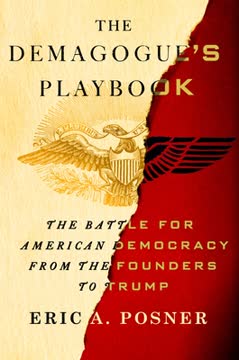
The Demagogue's Playbook examines American demagoguery from the Founders to Trump, exploring tensions between elite governance and popular rule. Reviewers appreciate Posner's historical survey of presidents and demagogues like Jackson, McCarthy, and Wallace, noting his analysis of divisive rhetoric, attacks on institutions, and manipulation of public emotions. While some praise the educational value and measured approach, others criticize the book for being too Trump-focused, lacking coherence, or showing obvious bias. Several readers found it tedious or derivative. Overall, reactions are mixed, with ratings averaging 3.81 out of 5, reflecting appreciation for historical content but concerns about execution and balance.
People Also Read