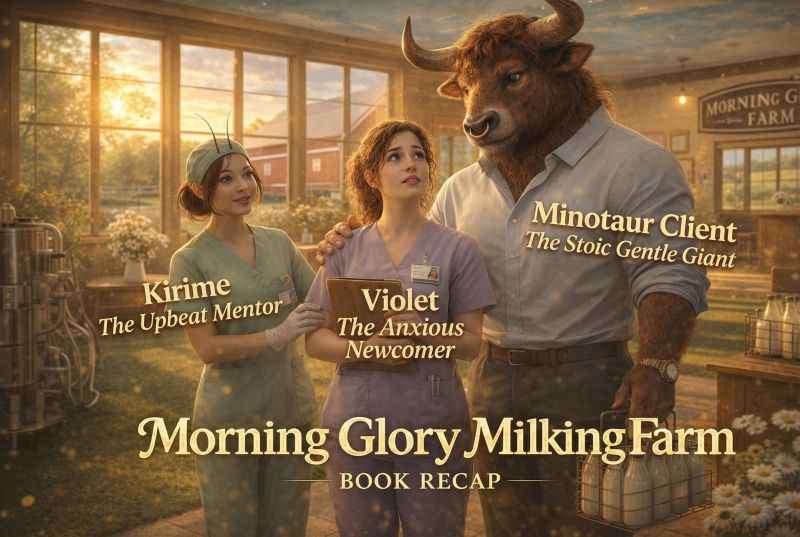
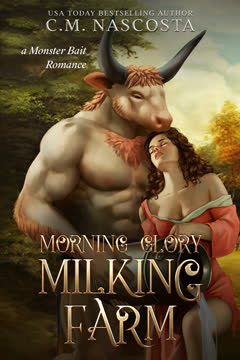

Plot Summary
Morning Glory's Help Wanted
Violet1 has a master's degree, maxed-out credit cards, and a mother begging her to move back to the garage loft. When a job listing for Morning Glory Farm pings her phone — full benefits, dental, no experience required — she applies before reading the fine print.
At orientation in Cambric Creek, a multi-species suburb, she joins a group of non-human applicants and watches a training video in which a fox-faced woman cheerfully demonstrates the collection process: gripping an erect minotaur's member, stroking it to completion, and bottling the result.
Minotaur semen, it turns out, is a key ingredient in pharmaceutical erectile dysfunction pills. Violet1 watches the video on loop from her apartment, cycling between mortification and the math of her bank account. The salary beats anything in her field. She clicks accept.
Below the Breeding Bench
Her trainer Kirime4 — a cheerful, antennaed girl with solid black eyes — walks her through a world of chrome and clinical protocol. The collection rooms are bi-level: minotaurs straddle a padded breeding bench on the upper floor, their anatomy protruding through an opening to the technician below.
Violet1 learns to sterilize bottles in the autoclave, hook collection tanks into the milking machine, and mop between clients. The sucking nozzles are wider than soda cans, textured with silicone nodules.
Kirime4 teaches her the unwritten taxonomy — Earners who track every drop for pay, Clockwatchers who want speed, Pop-n-Gos who finish instantly, and Good Little Cows who fetishize the process. It's pharmaceutical extraction, not sex work, Kirime4 insists. Violet1 grips a nozzle and tries to believe her.
The Clockwatcher Who Shuddered
He announces he's on his lunch break — broad-shouldered, messy pecan-brown hair, a gold ring spanning his pink nose. A textbook Clockwatcher. Violet1 takes her position beneath the bench as his impossibly thick cock fills the opening, blocking out the light.
She oils her gloves and begins stroking, discovering by accident that slipping her pinky beneath his foreskin draws a sharp intake of breath — an anomaly from the type of client who never shows anything. She presses the discovery, circling his cockhead from within the sensitive sheath, and he grunts.
When he comes, she cups his balls and feels every pulse of his orgasm throbbing through her palms. That night she finds a crisply folded hundred-dollar bill in her tip envelope. That night she brings herself to orgasm remembering the weight of him.
The Purple Sticker
Weeks pass, and Violet's1 life reshapes around the farm. Her bank balance climbs to four digits for the first time. She explores Cambric Creek's green markets and eclectic shops. Then a purple sticker appears on one of her files — a client request, meaning someone specifically asked for her.
It's the Clockwatcher. Rourke2 books the last Friday slot, and their sessions become weekly rituals layered with conversation. He asks if she's still in school; she tells him about her grad degree and the impossible job market. He recommends a local coffee shop.
She discovers that talking beforehand makes him arrive at the bench fully erect, and his tightly controlled groans during her milking sessions have become the most erotic sound she knows. She researches his horoscope from his chart. She reads about Capricorn compatibility. She has it bad.
Kidnapped by a Vampire
Violet1 ventures into the Black Sheep Beanery and is instantly overwhelmed — the only human in a crush of goblins, elves, and orcs. Before she can retreat, a platinum-blonde woman with heavy eyeliner links their arms and steers her to a table, chattering about someone named Byron as if they're old friends.
Her name is Geillis,3 a vampire turned outside a London concert hall in 1982, who grabbed Violet1 to avoid a client from her own peculiar job: draining blood donors at a vampire restaurant, where half the donors become aroused during extraction.
When Violet1 confesses she milks minotaurs for a living, Geillis3 dissolves into laughter. Their bond is instant — two women doing absurd, intimate work in a town built for species they don't belong to. Violet1 finally has a confidante.
Rourke Has a Name
On a free afternoon, Violet1 stops at the Black Sheep to meet Geillis.3 A familiar thunderclap voice orders behind her, and a huge warm hand touches the small of her back — the Clockwatcher, buying her coffee before she can object.
When the barista calls him Rourke2 and asks if he and someone named Lurielle5 are coming to her cookout, Violet's1 chest caves. She assumes Lurielle5 is a wife or girlfriend. Of course a handsome, successful minotaur with that voice wouldn't be single. She tells him coolly that she has a lunch date waiting and flees to Geillis's3 table.
From across the shop, the vampire3 sees everything and calls out the obvious: that was not just a client. Violet1 insists otherwise and plans to change her schedule. The honeycomb latte she usually savors tastes like ash.
Divorced, Not Taken
At his next appointment, Violet1 forces cheerfulness and asks about the cultural significance of the nose ring. Rourke2 explains it symbolizes being bound to another in marriage — then adds, in a low growl, that he's been divorced for about two years and simply hasn't had it removed.
She blurts out who Lurielle5 is. His frustration surfaces: Lurielle5 is his elf neighbor, who has a large orc boyfriend. The enormous gulf between them collapses in an instant. Violet1 admits her lunch date was just Geillis.3
He admits he's getting the ring removed that weekend — there's an incentive now to be symbolically back on the market. When he suggests they'll have to see about visiting that vampire restaurant together, the implication hangs between them like a shared breath. Everything has changed.
Coffee Without the Bench
Violet's1 great-aunt Gracie dies unexpectedly, and she flies home for two weeks of grief, funeral arrangements, and an awkward coffee with Carson Tinsley — her mother's6 matchmaking project. She returns to the farm raw and exhausted.
Rourke,2 minus his nose ring, is furious about her absence and being stuck with a replacement technician he claims nearly circumcised him. But when she tells him about the death, his entire demeanor shifts.
He cradles her face in his enormous hand and catches her tear with his thumb — the first time he's touched her outside the context of being milked. He asks her to leave the farm with him right now and get coffee. At the Black Sheep, he holds her hand across the table as she cries about her aunt. He asks her to dinner.
The Gentleman's Slow Campaign
Their first date is a trattoria near her apartment, two bottles of red wine, and a kiss on the sidewalk that nearly turns her inside out — his mouth wider than any human's, his tongue hot and rough. More dates follow: Cambric Creek restaurants, walks along the town's creek, gallery visits.
She meets Lurielle,5 his petite elf neighbor, who warns that Rourke2 steals bites of everyone's dessert. He pauses his farm appointments. He insists on paying for everything, telling her she holds all the cards and her comfort is the only priority.
He's giving her every chance to decide this isn't what she wants. Week after week she comes home alone, her vibrator earning its charging cord. She appreciates his restraint and the trust it builds between them. She's also losing her mind.
Under the Table Linens
Following a kitchen-table waxing session courtesy of Geillis,3 Violet1 wears nothing under her skirt to their next dinner at a restaurant with plush banquettes. Rourke's2 hand drifts to her thigh, discovers bare skin where fabric should be, and stills for one charged moment.
Then his fingers begin to move. He tells her in a low, commanding croon exactly how he plans to spoil her — with his tongue, with his cock, whenever she wants. She comes against his hand concealed by jacquard linens and his preternatural composure.
At her apartment afterward, he goes down on her — his wide, rough tongue as devastating as she'd fantasized — then refuses actual sex. She needs to be physically prepped for his size, and her apartment is too small for his frame. He tells her to pack a weekend bag.
Towels on the Nightstand
He greets her wearing nothing but a towel, his erection tenting the fabric. He insists on his protocol: her orgasm on his tongue before anything else. When he finally enters her, the stretch of his thick mid-shaft swell burns, but by the third thrust the pain ignites into blinding pleasure.
He takes her from behind and invokes the myth of the labyrinth — the tributes were given to appease the minotaur's lust, and they never left because they became addicted to the way they were filled. She screams when she comes. He erupts inside her with a roar, the sheer volume of his release overflowing and necessitating the towels stacked beside the bed. She realizes she may already be in love. He asks if she'll need to be carried to get ice cream.
Don't Unpack Everything
Three months into their relationship, a chain of connections through Lurielle5 leads to a research position at the Slade Foundation — restoring historic buildings in Cambric Creek, perfectly matching Violet's1 architecture degree.
She calls her mother6 to share the news about the job, the move, and her minotaur boyfriend — a conversation that needs time to settle. She interviews at the Black Sheep Beanery, the same shop where so much has happened, and during Rourke's2 milking session that afternoon, her phone buzzes with the offer.
She tells him as she tags his bottle, and he suggests she shouldn't unpack everything in her new apartment. The farm was supposed to be a stopgap, a lifeline until something better came along. It delivered something better in every way she hadn't thought to ask for.
Analysis
Violet's1 central arc — from debt-drowning grad student to empowered professional — is inseparable from her sexual awakening, and the novel refuses to treat these as competing narratives. The farm literalizes the commodification of bodies already embedded in pharmaceutical capitalism: human men's erections depend on minotaur semen, extracted by underpaid technicians told their work isn't sexual. This clinical framing mirrors real-world tensions faced by care workers, massage therapists, and phlebotomists whose professional touch exists in permanent negotiation with cultural taboos about bodily contact.
The multi-species worldbuilding functions as defamiliarization. By placing humans as the minority in Cambric Creek, Nascosta inverts the reader's default perspective. Violet's1 slow discovery that her human-centric worldview is provincial — a goblin forced to shop on the bottom shelf at a corner bodega, the realization that majority culture bleeds into everything — mirrors the real cognitive process of confronting privilege. The romance genre's traditional power dynamic between wealthy hero and financially precarious heroine is complicated by species: Rourke's2 dominance arrives with the vulnerability of being non-human in a human-dominated economy, his body literally harvested for pharmaceutical profit.
The novel's emotional intelligence lies in its pacing of consent. Rourke's2 insistence on slow courtship — pausing farm visits, telling Violet1 she holds all the cards, refusing sex until she's physically prepared — reads not as narrative teasing but as genuine reckoning with a relationship that began in asymmetric vulnerability. He was her client before her partner, and the story takes the ethical weight of that transition seriously. That the resolution pairs romantic fulfillment with professional achievement ensures the happily-ever-after isn't contingent on a man rescuing Violet1 from poverty, but on a community making room for her to rescue herself.
Review Summary
Morning Glory Milking Farm receives mixed reviews, with many praising its surprisingly sweet romance and world-building. Readers appreciate the slow-burn relationship between human Violet and minotaur Rourke, despite the unconventional premise. Some find the explicit content shocking but enjoyable, while others criticize the lack of plot. Many reviewers note the book's unexpected charm and humor. Common critiques include typos, timeline inconsistencies, and desire for more character development. Overall, the novel's unique concept and balance of romance and erotica garner both enthusiasm and hesitation from readers.
People Also Read





Characters
Violet
Debt-drowning milking technicianA human woman in her mid-twenties with a master's degree, an architecture specialization, and a bank account that makes both qualifications feel like cruel jokes. Violet is a perfectionist forged by anxiety—she memorizes training binders backward, gives herself parking-lot pep talks, and calculates earnings while lying in bed. Her compulsive need to excel transforms a mortifying job into a point of pride. Beneath the competence is a woman starved for belonging, raised in an all-human town where no one ever left, aching for something bigger. Her relationship with her mother6 is tender but suffocating, shaped by matching anxiety disorders neither fully acknowledges. She discovers that the courage she lacked in her stalled career comes naturally once she stops trying to fit a mold designed for someone else.
Rourke
Stern minotaur Clockwatcher clientA minotaur in his late thirties with messy pecan-brown hair, polished hooves, and a voice like a boardroom verdict. He owns an agricultural equipment company, wears impeccably tailored shirts, and is chronically incapable of taming his forelock. His stoic Clockwatcher demeanor at the farm masks a man who craves connection but trusts slowly. Raised between a minotaur settlement and a human town with a human grandmother, he occupies a cultural borderland that makes him empathetic to outsiders. His controlling nature is genuine but deliberately checked—he gives orders but repeatedly insists Violet1 holds all the cards. The tension between his natural dominance and careful respect for her autonomy defines him. He possesses a catastrophic sweet tooth, an aversion to gagging, and a surprising gentleness beneath the stern exterior.
Geillis
Vampire friend and confidanteA vampire turned outside a London concert hall in 1982, Geillis works at La Vie Rouge draining blood donors—some of whom become aroused during extraction. Platinum-haired, heavily eyelined, and relentlessly candid, she becomes Violet's1 first real friend in Cambric Creek by ambushing her at the coffee shop. Her advice ranges from interspecies dating wisdom to kitchen-table waxing sessions. She provides the blunt honesty Violet's1 anxiety won't allow her to give herself, and serves as living proof that strange jobs in strange towns can become real lives.
Kirime
Cheerful farm training partnerViolet's1 training partner at the farm, Kirime has solid black eyes, antennae hidden beneath her surgical cap, and an effortless cheerfulness that becomes Violet's1 model for professionalism. She teaches Violet1 the unwritten rules—which clients tip well, which require patience, when to deploy the milking machine—and defends her against the brusque schedule coordinator7. Her mantra that the job is pharmaceutical extraction, not sex work, anchors Violet's1 early resolve and helps normalize the surreal.
Lurielle
Rourke's elf neighbor and allyRourke's2 next-door neighbor, a petite elf with sapphire eyes and freckles, living in an oversized house she bought because nothing else was available. Her relationship with Khash8, a towering orc from the city, mirrors and informs Violet's1 own interspecies romance. Blunt and warm, she offers practical wisdom about mixed-species love—the rewards, the cultural friction, and the unsolicited comments from strangers. Her social connections ultimately lead Violet1 to the career opportunity that changes everything.
Violet's mother
Anxious, well-meaning parentA worrier with untreated anxiety who mirrors her daughter's1 nervous temperament. She pressures Violet1 to move home and date a safe, familiar human neighbor, representing the conventional life Violet1 is gradually outgrowing.
Magda
Brusque farm schedule coordinatorThe orc who organizes the farm's daily schedule. Impatient and slightly territorial, she represents the minor workplace friction that contrasts with the supportive environment most of Violet's1 coworkers provide.
Khash
Lurielle's towering orc boyfriendA syrupy-voiced Southern gentleman who lives across the river in the city. He embodies the practical complications of interspecies love across cultural divides, and offers Violet1 earnest financial advice about her student loans.
Donnaxa
Friendly farm file coordinatorThe cheerful beetle-woman who co-manages the farm's daily schedule alongside Magda7. Warm and encouraging, she delivers key information about cancellations and client requests with genuine goodwill.
Plot Devices
The Bi-Level Milking Room
Creates intimacy through architectureThe collection room's split-level design places the minotaur on a padded breeding bench above, his anatomy protruding through an opening to the technician below. This arrangement is the story's central spatial metaphor: Violet1 and Rourke2 know each other's most intimate physical details while remaining literally divided by a floor. The bench creates anonymity (scrubs, mask, and cap hide her identity), clinical distance (she faces machinery, not him), and paradoxical closeness (she holds his most sensitive flesh). Every escalation in their relationship maps onto this space—their first flirtation happens through the bench, their emotional breakthrough happens when she finally climbs the stairs to his level. The room functions as both sterile workplace and charged erotic theater.
The Purple Sticker
Formalizes desire as paperworkThe farm's client request system marks a file with a purple sticker when a client asks for a particular technician. In a facility designed around anonymity and interchangeability, the sticker is an act of declaration—the only sanctioned way to signal preference without knowing when the preferred technician works. Rourke's2 first purple sticker transforms Violet's1 routine into weekly anticipation, each Friday file check becoming a private ritual. The device also generates tension: stickers can be missed by schedulers, disrupted by cancellations, or complicated by trainee shadows. When Rourke2 books an unscheduled Tuesday, his sticker appearing mid-week signals escalating intent that breaks their established pattern and raises the emotional stakes.
The Gold Nose Ring
Marriage symbol and emotional barrierMinotaur tradition holds that a gold nose ring signifies being bound to another in marriage. Rourke's2 ring is introduced as a physical detail—gleaming under the collection room lights—long before its meaning is revealed. When Violet1 learns its cultural significance, the ring becomes visible proof of her worst fear: that he belongs to someone else. His subsequent disclosure that the marriage ended transforms the ring into something more complex—a symbol of emotional inertia, of a past he hasn't fully released. His decision to have it removed, explicitly timed to his growing feelings for Violet1, marks the story's emotional midpoint. Its absence in later scenes signals his readiness for a new beginning.
The Black Sheep Beanery
Neutral ground for transformationThe local coffee shop where species mingle over honeycomb lattes and chlorophyll chillers serves as the story's recurring meeting ground outside the farm's clinical walls. Violet1 first enters as an overwhelmed outsider; she meets Geillis3 there, encounters Rourke2 out of context there, has her first real date there, and ultimately interviews for her dream job there. Each visit marks deeper integration into Cambric Creek's community. The caprine owners connect to Rourke's2 social network, making the Beanery a node where Violet's1 professional, romantic, and social worlds converge into one coherent life.
The Tip Envelopes
Economic tracker of connectionSky-blue envelopes containing cash tips are collected at the reception desk after each shift. Rourke's2 crisply folded hundred-dollar bills—sharp-edged, perfectly creased—stand out among crumpled twenties from other clients, marking his anonymous presence even before Violet1 knows his name. The envelopes track her financial recovery in miniature: early tips fund groceries, later ones supplement credit card payments, and eventually they represent discretionary spending rather than survival. The precision of Rourke's2 folding foreshadows his personality before she knows anything else about him. The tips occupy the same ambiguous territory as their entire early relationship—simultaneously professional acknowledgment and intimate gesture.
FAQ
Synopsis & Basic Details
What is Morning Glory Milking Farm about?
- Unconventional Job Search: Violet, a recent graduate struggling with debt, discovers an unusual job opportunity at Morning Glory Milking Farm, a facility that collects semen from minotaurs for pharmaceutical purposes.
- Embracing the Unforeseen: Despite her initial shock and the pressure to return home, Violet decides to take the unconventional job, drawn by the promise of financial stability and benefits.
- Finding Community: As Violet navigates the peculiarities of her new role, she encounters a diverse community of non-human beings and begins to find her place in the unconventional town of Cambric Creek.
Why should I read Morning Glory Milking Farm?
- Unique Premise: The story offers a fresh and imaginative take on romance, blending elements of fantasy with contemporary themes of financial struggle and self-discovery.
- Character-Driven Narrative: Readers will connect with Violet's relatable journey as she navigates her anxieties, embraces her sexuality, and finds love in an unexpected place.
- Exploration of Acceptance: The novel celebrates diversity and challenges societal norms, promoting a message of acceptance and the importance of forging one's own path.
What is the background of Morning Glory Milking Farm?
- Contemporary Setting: The story is set in a contemporary world where humans and various non-human species coexist, though societal biases and cultural differences still exist.
- Pharmaceutical Industry Satire: The narrative subtly satirizes the pharmaceutical industry's pursuit of profit, highlighting the lengths to which companies will go to create and market products.
- Cultural Blend: Cambric Creek is portrayed as a town that embraces diversity, with accommodative architecture and businesses catering to a multi-species population.
What are the most memorable quotes in Morning Glory Milking Farm?
- "The goal for every client is a plentiful, speedy collection.": This quote encapsulates the farm's efficiency-driven approach and the somewhat dehumanizing nature of Violet's job.
- "It's not that common an occurrence...it's a very good incentive to not be slow with the nozzle.": This quote highlights the practical and sometimes absurd realities of Violet's work, blending humor with the underlying pressure to perform.
- "You're going to be good at this.": This recurring phrase, both an internal mantra and an external encouragement, underscores Violet's determination to succeed despite her initial reservations and the challenges she faces.
What writing style, narrative choices, and literary techniques does C.M. Nascosta use?
- First-Person Perspective: The story is told from Violet's point of view, allowing readers to intimately experience her thoughts, feelings, and evolving perceptions.
- Humorous Tone: Nascosta employs a witty and self-aware tone, using humor to explore potentially sensitive or taboo subjects and to create a lighthearted reading experience.
- Descriptive Language: The author uses vivid and evocative language to bring the world of Morning Glory Farm and Cambric Creek to life, immersing readers in the story's unique setting.
Hidden Details & Subtle Connections
What are some minor details that add significant meaning?
- The Old-Fashioned Milk Bottles: The use of old-fashioned milk bottles for collecting semen creates a jarring contrast between the modern pharmaceutical industry and a nostalgic, almost pastoral aesthetic, highlighting the absurdity of the situation.
- The Names of the Coffee Drinks: The unique names of the coffee drinks at the Black Sheep Beanery reflect the diverse clientele and the blending of cultures in Cambric Creek, adding depth to the setting.
- The Color-Coded Cleaning Sprays: The color-coded spray bottles with different scents (orange for the breeding bench, industrial for the floor) emphasize the clinical cleanliness required while also hinting at the underlying nature of the work.
What are some subtle foreshadowing and callbacks?
- Violet's Initial Discomfort: Violet's initial discomfort and anxiety during the training video foreshadow her later emotional and sexual awakening, as well as her eventual acceptance of her role.
- The Mention of Other Facilities: The mention of other semen collection facilities and organ trade-in places foreshadows the normalization of the unconventional job and its place within a larger, albeit hidden, industry.
- The Description of the Clockwatcher's Tailoring: The description of the Clockwatcher's well-tailored clothing and expensive accessories foreshadows his later generosity and hints at his higher social standing.
What are some unexpected character connections?
- Geillis's Connection to the Vampire Restaurant: Geillis's connection to the vampire restaurant and its "menu donors" parallels Violet's job at the milking farm, highlighting the normalization of unconventional industries within the community.
- Rourke's Relationship with Xenna and Lurielle: Rourke's existing relationships with Xenna and Lurielle reveal his integration into the Cambric Creek community and challenge Violet's initial assumptions about his social life.
- The Ogress's Knowledge of Scrub Preferences: The ogress's knowledge of the clients' scrub preferences reveals a hidden layer of the job, suggesting that the technicians are sometimes expected to cater to specific fantasies.
Who are the most significant supporting characters?
- Kirime: Kirime serves as Violet's guide and mentor, providing practical advice and emotional support as she navigates the challenges of her new job.
- Geillis: Geillis offers Violet a sense of belonging and introduces her to the vibrant community of Cambric Creek, helping her to embrace her individuality and find joy in unexpected connections.
- Lurielle: Lurielle provides Violet with insights into the complexities of interspecies relationships and offers a realistic perspective on the challenges and rewards of building a life in Cambric Creek.
Psychological, Emotional, & Relational Analysis
What are some unspoken motivations of the characters?
- Violet's Fear of Returning Home: Violet's unspoken motivation is to avoid returning to her small hometown and conforming to her mother's expectations, driving her to persevere in the unconventional job despite her initial reservations.
- Rourke's Desire for Connection: Rourke's unspoken motivation is to find a genuine connection and companionship after his divorce, leading him to seek out Violet and explore a relationship beyond the confines of the farm.
- Geillis's Need for Acceptance: Geillis's unspoken motivation is to find acceptance and belonging within the Cambric Creek community, leading her to befriend Violet and share her experiences as a vampire.
What psychological complexities do the characters exhibit?
- Violet's Anxiety and Perfectionism: Violet struggles with anxiety and a need for perfection, which manifests in her frantic note-taking and her fear of failure in her new job.
- Rourke's Stoicism and Control: Rourke exhibits a stoic demeanor and a need for control, which stems from his past experiences and his desire to maintain order in his life.
- Geillis's Blasé Attitude: Geillis's blasé attitude towards her job and her past is a coping mechanism for dealing with the challenges and complexities of being a vampire.
What are the major emotional turning points?
- Violet's First Solo Milking Session: Violet's first solo milking session with Rourke marks a turning point in her emotional journey, as she begins to develop feelings for him and to see the minotaurs as individuals.
- The Death of Aunt Gracie: The death of Aunt Gracie prompts Violet to reevaluate her priorities and to embrace the opportunities before her, leading her to commit to her life in Cambric Creek.
- The Revelation of Rourke's Divorce: The revelation of Rourke's divorce and his subsequent interest in Violet marks a turning point in their relationship, as they both acknowledge their feelings and decide to explore a deeper connection.
How do relationship dynamics evolve?
- Violet and Rourke's Relationship: Violet and Rourke's relationship evolves from a professional interaction to a friendship to a romantic partnership, marked by increasing intimacy and vulnerability.
- Violet and Geillis's Friendship: Violet and Geillis's friendship evolves from a chance encounter to a supportive and understanding bond, as they share their experiences and offer each other guidance.
- Violet and Her Mother's Relationship: Violet and her mother's relationship evolves from a source of tension and pressure to a more understanding and supportive dynamic, as Violet establishes her independence and finds happiness in her own way.
Interpretation & Debate
Which parts of the story remain ambiguous or open-ended?
- The Future of the Pharmaceutical Industry: The story leaves open the question of whether the pharmaceutical industry will continue to rely on unconventional methods of production, or if new technologies will emerge.
- The Long-Term Impact of Interspecies Relationships: The story does not fully explore the long-term impact of interspecies relationships on society, leaving open the question of whether such relationships will become more widely accepted and normalized.
- The Specifics of Rourke's Business: The exact nature of Rourke's business and his role in the community are not fully detailed, leaving room for speculation about his influence and power.
What are some debatable, controversial scenes or moments in Morning Glory Milking Farm?
- The Milking Scenes: The graphic descriptions of the milking process may be considered controversial by some readers, raising questions about the ethics of commodifying sexuality and the objectification of the minotaurs.
- The Power Dynamics Between Violet and Rourke: The power dynamics between Violet and Rourke, particularly in the context of their professional relationship, may be debated, with some readers questioning whether their relationship is truly consensual.
- The Portrayal of Non-Human Species: The portrayal of non-human species and their cultural practices may be debated, with some readers questioning whether the author's depictions are respectful and accurate.
Morning Glory Milking Farm Ending Explained: How It Ends & What It Means
- Violet's Acceptance of Her New Life: The ending signifies Violet's complete acceptance of her new life in Cambric Creek, as she embraces her relationship with Rourke and secures a fulfilling job that aligns with her passions.
- The Importance of Community and Connection: The ending emphasizes the importance of community and connection, as Violet finds support and belonging in her relationships with Rourke, Geillis, and the other residents of Cambric Creek.
- A Celebration of Unconventional Love: The ending celebrates unconventional love and the courage to forge one's own path, as Violet and Rourke commit to building a life together despite the challenges of their interspecies relationship.
Download PDF
Download EPUB
.epub digital book format is ideal for reading ebooks on phones, tablets, and e-readers.








































