Key Takeaways
1. Language Communities as Enduring Historical Units
Far more than princes, states or economies, it is language-communities who are the real players in world history, persisting through the ages, clearly and consciously perceived by their speakers as symbols of identity, but nonetheless gradually changing, and perhaps splitting or even merging as the communities react to new realities.
Defining humanity. Language communities are the fundamental units of human history, linking speakers into traditions that span millennia. Unlike transient political entities or biological lineages, a shared language enables collective action and the transmission of common memories, making it the primary medium for both living and telling history. This perspective offers a clearer lens than race or nation, whose boundaries are often arbitrary or fluid.
Immortal traditions. Every living language embodies a tradition, passed from old to young, granting it a theoretical chance at immortality. This transmission process, while allowing for gradual change, does not inherently lead to decay or extinction. Just as life renews itself, each generation can receive the gift of its language afresh, ensuring its continuity.
Dynamic evolution. Despite this potential for immortality, the actual lifespans of language communities vary enormously. Languages are dynamic entities, constantly changing, splitting, or merging as their communities adapt to new realities. This interplay of persistence and transformation is a central, often overlooked, aspect of world history.
2. Literacy's Transformative Power in Language History
All this is resolved through the miracle of writing.
Beyond oral memory. Oral traditions, while rich in lore, are inherently subjective and limited in scope, constantly pressured to update to contemporary needs. Writing, however, provides an objective and permanent record, transforming ephemeral speech into enduring historical evidence. This shift from memory to inscription marks the true beginning of documented language history.
From tokens to thought. Writing systems often originated from practical accounting records, like clay tokens for transactions. Over time, these symbols evolved to capture the full complexity of spoken language, allowing for the explicit recording of human life and thought. This development enabled cultures to preserve not just broad events, but also intricate details like diplomatic dialogues, myths, laws, and love songs.
Shaping linguistic destiny. The adoption of writing systems, even when borrowed, profoundly influenced language development. While some cultures, like the Egyptians and Chinese, maintained their complex indigenous scripts for millennia, others, like the Phoenicians, radically simplified them into alphabets. This innovation democratized literacy, opening positions of power beyond aristocratic scribal classes and revolutionizing communication, though paradoxically, the original language cultures often resisted adopting these simpler forms for themselves.
3. The Middle East: A Cradle of Linguistic Innovation
This is the area where we find the first conscious use of a classical language; but also, by contrast, the first generalised use of a totally foreign language for convenience in communication, as a lingua franca, an early apparent triumph of diplomatic pragmatism over national sentiment.
Pioneering linguistic concepts. The ancient Near East was a crucible of linguistic innovation, consciously multilingual from its earliest records. It gave the world:
- The first classical language (Sumerian), canonized and studied long after its spoken demise.
- The first widespread lingua franca (Aramaic), adopted for convenience across empires.
- The invention of writing (Sumerian cuneiform) and its radical simplification into the alphabet (Phoenician).
A Semitic thread. The region's linguistic history is dominated by the enduring Semitic family, linking Akkadian (2300 BC), Aramaic (600 BC), and Arabic (AD 600). These sister languages, with shared phonetic and grammatical features, demonstrate remarkable continuity over 4,500 years, persisting through numerous political upheavals and foreign conquests.
Cosmopolitanism and faith. Middle Eastern societies were inherently cosmopolitan, fostering multilingualism. This environment also gave rise to the "Shield of Faith" strategy for language survival, where religious identity became intertwined with linguistic preservation. Hebrew, Syriac (Aramaic), and Coptic (Egyptian) endured centuries of adversity by becoming the sacred languages of distinct religious communities, a testament to faith's power in sustaining linguistic heritage.
4. Resilience of Sedentary Civilizations (Egypt & China)
Both maintained this position of solitary and basically unchanging dominance for an awesome period of over three thousand years, or more than 120 generations.
Unmatched stability. Egyptian and Chinese stand as unparalleled examples of linguistic stability, maintaining their dominance within their homelands for over three millennia. Despite repeated invasions and political turmoil, their languages absorbed external pressures without being supplanted, a stark contrast to the more volatile linguistic histories of other regions.
Pillars of persistence. This extraordinary resilience stemmed from a combination of factors:
- High population density: Large, settled populations, sustained by fertile river valleys (Nile, Huang-he, Yangtze), simply overwhelmed incoming groups.
- Strong central authority: A unified state, often with a divinely sanctioned emperor/pharaoh, provided a stable political and cultural core.
- Cultural self-regard: Both civilizations possessed immense cultural prestige, leading invaders to adopt the local language and customs rather than imposing their own.
Absorbing invaders. Conquerors, from the Hyksos in Egypt to the Manchu in China, often found themselves culturally assimilated, their languages fading within generations. Both cultures also maintained their unique, complex writing systems, resisting simpler alphabetic innovations. This steadfast adherence to tradition, even with its high educational overhead, underscored their deep-seated cultural confidence and contributed to their linguistic continuity.
5. Sanskrit's Cultural Diffusion Without Conquest
Nowhere has this linguistic contact led to loss or replacement of other linguistic traditions, even though Sanskrit has always been central to new cultural developments wherever it has reached.
A creeper of culture. Sanskrit, meaning "composed" or "synthesized," spread across the Indian subcontinent and throughout Southeast Asia, Tibet, China, Korea, and Japan, not through military conquest, but as a vehicle of high culture and religion (Hinduism and Buddhism). This "soft power" expansion is a unique historical phenomenon, contrasting sharply with the often-devastating impact of military-driven language spreads.
Intrinsic charm and rigor. Sanskrit's allure lay in its:
- Rigorous linguistic analysis: Grammar was a central discipline, defining the language with unparalleled precision.
- Vast literary tradition: Encompassing epic poetry, philosophy, science, and drama, it offered a rich intellectual heritage.
- Elaborate structure: Polysyllabic words, complex inflections, and a penchant for punning showcased its luxuriant expressive power.
Elite adoption, not displacement. Sanskrit became the language of elite discourse and sacred expression, permeating local languages with borrowed terminology without replacing them. Its status as an artificial, perfected language made it irresistibly attractive to upwardly mobile institutions and dynasties seeking legitimacy and prestige. This cultural assimilation, often without coercion, allowed Sanskrit to inspire new civilizations while respecting existing linguistic traditions.
6. Greek's Prestige and Imperial Reach
Greek’s influence was eclipsed only when it ran out of new alliances, and was forced to face alone an unsympathetic enemy which drew its cultural support elsewhere.
From city-states to empire. Greek, initially a collection of diverse dialects, unified around Attic Greek due to Athens' commercial and cultural prestige. Its global spread began with colonization across the Mediterranean and Black Sea, followed by Alexander's conquests, which established Greek as the administrative language across the Near East for centuries.
Roman admiration, Christian vehicle. Greek's enduring influence was cemented by the Romans, who, despite their military dominance, adopted Greek as the language of arts, sciences, and higher education. Later, it became the primary language of the early Christian Church, providing a new, secularized vehicle for its spread and solidifying its status as a universal language in the eastern Roman Empire.
Decline and retrenchment. Despite its long and illustrious career, Greek eventually faced decline. In the East, it yielded to Aramaic and Arabic after Muslim conquests, while in its homeland, Slavic invasions led to periods of severe contraction. The fall of Constantinople to the Turks in 1453 marked the end of its imperial role, confining it to a conquered people's tongue, preserved by Orthodox faith but stripped of its universal aspirations.
7. Latin's Dual Fate: Imperial Spread and Vernacular Divergence
Once written Latin had become established as a distinct, if not yet foreign, language, occasions began to arise when there was a need to write down something that would explicitly record the sounds of a vernacular.
Roman expansion, linguistic imposition. Latin's spread was inextricably linked to the Roman Empire's military and political might. Through conquest, colonization, and the extension of Roman citizenship, Latin replaced indigenous Celtic languages across Italy, Gaul, and Iberia, becoming the dominant vernacular. This process was driven by Rome's civic organization and its ability to integrate conquered peoples into its administrative and economic system.
The "first death": Birth of Romance. As the Western Roman Empire dissolved under Germanic invasions, the spoken Latin of its provinces began to diverge. The breakdown of centralized administration and education, coupled with the influence of Germanic substrata, led to the gradual emergence of distinct Romance vernaculars. This period saw Latin, or grammatica, become increasingly perceived as a separate, learned language, distinct from the everyday idioma of the people.
The "second death": Print and vernacular triumph. The invention of the printing press in the 15th century delivered the final blow to Latin's universal intellectual dominance. Mass-produced books in vernacular languages, championed by movements like the Reformation, rapidly eclipsed Latin's role in literature, science, and public discourse. Latin, once the living language of empire and learning, was relegated to a purely classical, artificial status, marking its effective "death" as a language of active communication and innovation.
8. European Maritime Empires: New Modes of Language Spread
The Spanish and the Portuguese discovered, in the late fifteenth century, that a new technology, the ocean-going ship, powered by sail, and guided by the magnetic compass and an evolving knowledge of prevailing winds, could give them direct access to distant parts of the world.
Global reach, unprecedented impact. The late 15th century marked a radical shift in language spread, as European powers leveraged ocean-going ships to establish direct links with distant continents. This new era of global navigation created discontinuous speech communities across the world, fundamentally altering the dynamics of linguistic interaction.
Sweep-aside and re-education. This expansion led to two primary models of language spread:
- Sweep-aside: In sparsely populated or disease-ravaged regions (e.g., the Americas, Australia), European settlers displaced or overwhelmed indigenous populations, establishing their languages as dominant vernaculars.
- Re-education: In densely populated, established civilizations (e.g., India, Southeast Asia), colonial languages were adopted by local elites as symbols of cultural recruitment and access to modern knowledge, often without mass migration.
Diverse imperial outcomes. European empires (Spanish, Portuguese, French, Dutch, English, Russian) pursued varied motives—wealth, religious conversion, national glory—resulting in a spectrum of linguistic legacies. From the near-total linguistic replacement in Brazil to the superficial lingua franca status of Dutch in Indonesia, the outcomes demonstrate that imperial power alone did not guarantee the spread of the colonizer's language.
9. The Paradox of Imperial Language Spread
Evidently, total conquest, military and even spiritual, is not always enough to effect a language change.
Beyond brute force. Military conquest and economic dominance, while powerful, do not automatically lead to the linguistic subjugation of conquered peoples. Numerous historical examples demonstrate this paradox:
- Germanic invasions of Rome: Franks, Vandals, and Goths established kingdoms across Western Europe but largely adopted Latin, failing to impose their own languages.
- Dutch in the East Indies: Despite centuries of colonial rule, Dutch never became a widespread language, with Malay serving as the lingua franca.
The role of migration and population shifts. Successful language spread often hinges on demographic factors:
- Mass immigration: Conquerors arriving in overwhelming numbers, like the Romans in Gaul or English settlers in North America, could displace or assimilate existing populations.
- Population collapse: Epidemics, as in the Americas, drastically altered demographic balances, facilitating the dominance of the colonizer's language.
Cultural and pragmatic incentives. Beyond sheer numbers, the perceived benefits of adopting the conqueror's language played a crucial role. Access to a more developed civilization, economic opportunities, or religious advancement could incentivize linguistic shifts, as seen with Latin in Gaul or English education in India. However, this "re-education" model is more fragile and less permanent than direct population replacement.
10. English: A Microcosm of Global Language Dynamics
The history of English, at least as viewed from the beginning of the twenty-first century, falls into two very unequal periods: one of formation, from the fifth to the end of the sixteenth centuries, during which the language took shape, growing up in the island of Britain; and one of propagation, from the seventeenth century to the present, in which it took ship, spreading to every continent of the world.
A unique formation. English's early history is a testament to resilience. It coalesced from Germanic dialects in Britain, uniquely resisting the fate of other Germanic languages that were absorbed by Romance. It then assimilated its Norman French conquerors, re-emerging as the dominant language of the realm, and expanded into Celtic-speaking areas of the British Isles.
Global propagation. The propagation phase saw English spread worldwide through diverse means:
- Settler displacement: In North America and Australia, English speakers established populous communities, displacing indigenous languages.
- Elite re-education: In India and other Asian/African colonies, English became the language of administration and education for local elites.
- Technological leadership: The Industrial Revolution and subsequent communication technologies (printing, telegraph, broadcasting, internet) were predominantly developed and disseminated in English, cementing its global scientific and commercial role.
Worldly prestige. English's current global dominance is rooted in its association with wealth, technical progress, and popular culture. This "businessman's friend" image, reinforced by the economic and cultural power of the USA, has made English the world's leading lingua franca, attracting vast numbers of second-language learners and making it a unique summary of global language dynamics.
11. The Fragility of Global Language Dominance
The world remains a highly dynamic place. For languages, as for any human institution, when you are on top, sooner or later there is only one way to go.
No eternal reign. Despite English's unprecedented global reach, historical patterns demonstrate that no language's pre-eminence is eternal. Past world languages like Akkadian, Greek, and Latin, once seemingly unassailable, eventually declined or transformed, highlighting the inherent dynamism of linguistic landscapes.
Future challenges. English faces multiple threats to its long-term dominance:
- Demographic shifts: Native English speaker populations are stabilizing or declining, while other major languages (Chinese, Hindi-Urdu, Spanish, Arabic) continue rapid growth.
- Cultural resistance: Post-colonial nations may increasingly resist English as a symbol of past domination, promoting indigenous or alternative lingua francas.
- Dialectal fission: As English spreads and adapts globally, it may fragment into mutually unintelligible varieties, mirroring the fate of Latin into Romance languages.
Shifting equilibria. The rise of new economic and cultural power blocs (e.g., Chinese, Arabic, Turkic) and the inherent human tendency to multiply languages suggest that English's current position is not immutable. While its role as a global lingua franca may persist, its overall dominance as a first language and its cultural prestige could diminish, leading to a more multipolar linguistic world.
12. Language Learnability and Structural Affinity
Languages, we suggest, are more easily learnt by a new population, and hence spread more easily, when they are structurally similar to the old language of that population.
Substrate influence in adult learning. While children effortlessly acquire any natural language, adult learners often retain features of their native tongue (the "substrate"), which can influence their acquisition of a new language. This structural affinity, or lack thereof, can significantly impact a language's spread.
Structural similarity as a facilitator. Historical examples suggest that languages spread more effectively when they are structurally similar to the languages of the adopting population:
- Arabic: Successfully replaced Aramaic (a closely related Semitic language) across the Fertile Crescent, but struggled to take root in Indo-European speaking Persia and Spain.
- Greek: Flourished in Indo-European Anatolia (structurally similar languages) but had limited popular penetration in Semitic/Egyptian-speaking regions.
- Latin: Rapidly replaced Gaulish in Western Europe, partly due to structural similarities between the two Indo-European language families.
A hidden factor in language dynamics. This controversial hypothesis suggests that beyond military force, economic incentives, or cultural prestige, the inherent structural properties of languages play a role in their long-term viability and spread. When a new language is too structurally dissimilar to the existing one, its adoption by a large population becomes an arduous, often unsuccessful, struggle.
Review Summary
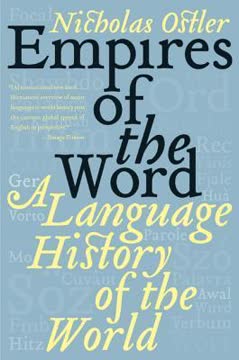
Reviews of Empires of the Word are largely positive, praising its encyclopedic scope and unique lens on world history through language spread and decline. Many readers find it fascinating yet dense, noting it can be dry and overly detailed at times. Strengths include its avoidance of Eurocentrism, rich anecdotes, and insightful analysis of why languages rise and fall. Critics note it can be a slog, with some sections feeling overly academic. Most agree it is an impressive, if challenging, achievement in documenting humanity's linguistic history.