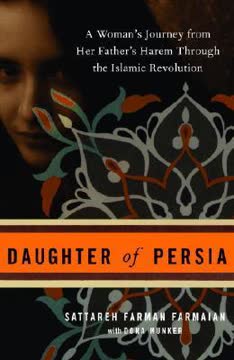
Key Takeaways
1. A Father's Vision: Education and Self-Reliance
"Nothing is more important, he would admonish us, than your education. Don't think that you can go about with your noses in the air because of who your father is, as though you were everyone else's superior. Never mind if ignorant people like your lalehs and nannies call you 'prince' or 'princess'; all that sort of thing is over for us. Times are changing, and what counts nowadays is not who your father was but what you make of your own lives."
Shazdeh's progressive ideals. Sattareh's father, Prince Abdol Hossein Farman Farmaian, a Qajar nobleman, instilled in his 36 children, including his daughters, a profound belief in education and self-reliance. Despite his immense wealth and status, he foresaw a changing Iran where inherited privilege would no longer guarantee survival. He emphasized that personal achievement, not lineage, would define their worth.
Cultivating independence. Shazdeh's methods were unconventional for his time and class. He ensured all his children, boys and girls, received rigorous schooling and physical training. He taught them to swim, ride, and face challenges head-on, believing that courage and self-sufficiency were essential for navigating life's storms. This radical approach aimed to equip them with the inner strength needed when his protection was no longer available.
The bond of "bread and salt." Within the compound, Shazdeh fostered a sense of collective responsibility and justice, extending care to over a thousand dependents. This "bond of bread and salt" created an indissoluble connection, where everyone, from the highest-ranking son to the humblest servant, understood their reliance on him. This early exposure to a microcosm of a just society deeply influenced Sattareh's later aspirations for her nation.
2. Challenging "Zaifeh": A Woman's Quest for Purpose
"I was sure that Shazdeh could have explained, but I never talked to him alone, and even if I could have, I would not have dared to engage my lofty, distinguished father in such intimate discourse. I would just have to wait. Maybe at school I would find the answers to these baffling riddles."
Defying traditional roles. Sattareh, an energetic and willful girl, chafed against the traditional Persian expectation of women as "zaifeh" (the weak sex), meant to be meek and self-effacing. Her mother, though devout, allowed her to play with boys in the biruni, fostering a sense of equality. This early freedom, combined with Shazdeh's emphasis on education, fueled Sattareh's desire for a life beyond the confines of the andarun.
The sting of dismissal. Her father's casual dismissal of her desire to study abroad—"It would be a waste of money. She is a woman. A woman will be nothing"—was a profound humiliation. This moment solidified her resolve to prove that women were capable of achieving something significant. It ignited a fierce determination to pursue an education that would enable her to serve her country.
Seeking answers beyond home. The American School for Girls, with its emphasis on dance, music, and open discussion, offered a stark contrast to her pious home. Here, she encountered diverse perspectives and the concept of "azadi" (freedom), which she realized meant more than just absence of imprisonment. This environment, coupled with the stark realities of poverty she witnessed at a missionary dispensary, propelled her quest for knowledge and a meaningful purpose.
3. The Paradox of Reza Shah's Modernization
"People agreed that although the new ruler had a heavy hand, he had accomplished something no one else had: he had converted anarchy into order."
Order at a high cost. Reza Shah Pahlavi, who rose to power through a British-engineered coup, brought unprecedented order and infrastructure to a chaotic Iran. He built roads, railways, and schools, aiming to transform Iran into a modern, Western-style nation. However, this modernization came at the expense of political freedom, as he systematically suppressed dissent, abolished independent institutions, and established a fearsome secret police.
Forced secularization. The Shah's reforms included controversial measures like outlawing the veil and forcing men to wear Western headgear, directly challenging deeply ingrained religious traditions. While he aimed to reduce the clergy's influence and promote a secular society, these actions alienated vast segments of the population, particularly devout women and bazaar merchants, who saw them as an attack on Islam.
A legacy of mixed feelings. Despite his tyranny and injustices, including the confiscation of Qajar lands and the murder of opponents like Sattareh's half-brother Nosratdoleh, Reza Shah's achievements in national unity and infrastructure were undeniable. His fall in 1941, orchestrated by the Allies, revealed the fragility of his power and the deep-seated resentment he had cultivated, yet also left a vacuum of leadership and a nation unprepared for true democracy.
4. America: A Beacon of Freedom, a Source of Disillusionment
"The United States, having foisted on us a leader who had never allowed any other leaders to develop, seemed to have no policy for dealing with the eventuality that he might not survive."
The allure of "Yengeh Donya." For Sattareh and many enlightened Iranians, America, "the land at the end of the earth," represented sincerity, selflessness, and a commitment to self-governance, a stark contrast to the exploitative British and Russians. Figures like W. Morgan Shuster and President Woodrow Wilson, who championed Iran's sovereignty, fostered a deep admiration and hope for American support in their nation's struggle for independence.
Cultural immersion and revelation. Sattareh's arrival in America was a series of cultural shocks and profound insights. She marveled at the abundance, the open houses without walls, and the freedom of expression in classrooms and media. She observed Americans' "initiative" and their ability to unite for common causes, realizing that open dialogue and collective action were the bedrock of their confidence and progress.
The bitter taste of betrayal. This admiration turned to bitter disillusionment with the 1953 CIA-orchestrated overthrow of Prime Minister Mossadegh. America, once seen as a moral ally, became another foreign power manipulating Iran for its own interests, particularly oil and anti-communism. This act, and the subsequent support for the Shah's increasingly repressive regime, shattered Iranian trust and fueled a deep-seated anti-American sentiment, leaving Sattareh to conclude that nations act solely out of self-interest.
5. Social Work: Building Foundations for a Nation
"I had found the weapon I needed to fight Iran's human miseries."
A practical path to change. After years of study and work with the United Nations, Sattareh discovered social work as the most effective means to address Iran's pervasive poverty, illiteracy, and disease. Unlike abstract theories, social work offered concrete methods to empower individuals and communities, fostering self-reliance rather than dependence on charity. This became her mission: to establish the profession in Iran.
Laying the groundwork. Returning to Tehran, Sattareh founded the Tehran School of Social Work, an independent institution dedicated to training "madadkar" (helpers). She designed a rigorous curriculum, emphasizing not only professional skills like hygiene, nutrition, and family planning, but also civic responsibility, community loyalty, and critical thinking—qualities often suppressed under the Pahlavi regime.
Transforming lives, inspiring hope. The School's early successes, from rehabilitating neglected orphans to establishing community welfare centers, demonstrated the power of organized social programs. Sattareh's students, initially shy and divided, transformed into dedicated professionals, earning respect and trust from the public. Their work, often in the face of immense challenges and official indifference, proved that Iranians could collectively address their problems and build a better future.
6. The Perilous Dance with Political Power
"I was determined to disregard the past."
Navigating a dictatorial landscape. Establishing an independent institution in the Shah's Iran required a delicate balance. Sattareh, a relative of the exiled Mossadegh, had to secure government backing without compromising the School's integrity or becoming entangled in the regime's pervasive corruption. Her strategy was to focus solely on social welfare, avoiding politics and leveraging family connections to gain influence.
A calculated risk. Her pivotal meeting with Mohammed Reza Shah, though fraught with tension and personal history, secured crucial funding and official endorsement. Sattareh's directness and unwavering focus on the practical benefits of social work, even when challenging the Shah's perception of "excellent" institutions, proved effective. This interaction highlighted the Shah's desire for visible progress, even if his understanding of human development was limited.
The cost of neutrality. Despite her efforts to remain apolitical, the School operated under the constant shadow of SAVAK and the Shah's unpredictable authoritarianism. The brutal raid on Tehran University and the imprisonment of reform-minded officials underscored the dangers of dissent. Sattareh's commitment to her students' safety and the School's mission meant enforcing strict non-political conduct, a difficult compromise in a society seething with suppressed anger.
7. The Revolution's Unforeseen Betrayals
"The Shah's overthrow had opened everyone's hand, and people were revealing their true nature."
A nation's boiling rage. The Shah's "White Revolution," despite some genuine advancements, failed to address deep-seated economic disparities, political repression, and cultural alienation. Inflation, unemployment, and the ostentatious wealth of a new elite fueled widespread resentment. Ayatollah Khomeini, from exile, skillfully tapped into this anger, portraying the Shah as an enemy of Islam and a tool of Western imperialism, promising justice and prosperity for the "dispossessed."
The illusion of unity. The initial euphoria of the Shah's departure and Khomeini's return was quickly replaced by chaos and vengefulness. Sattareh witnessed the rapid disintegration of order, as various factions, including her own students, turned on perceived "oppressors." The public execution of former officials, often after sham trials, and the widespread looting revealed a society consumed by opportunism and a desire for retribution, rather than the promised justice.
Personal and professional devastation. Sattareh's arrest by her own students, based on absurd accusations of "imperialism" and "Zionism," was a profound betrayal. It exposed the fragility of the trust she had painstakingly built and the deep-seated ingratitude that festered beneath the surface of Iranian society. Her life's work, the School of Social Work, was seized and its principles distorted, leaving her heartbroken and questioning the very nature of her countrymen.
8. Integrity's Cost in a Shifting Landscape
"I had always believed that human beings ought to turn to God for help only when they had done all they could to help themselves."
A test of principles. During her interrogation, Sattareh faced accusations that challenged her core beliefs and integrity. Despite the terrifying circumstances and the threat of execution, she refused to compromise her truth, defending her work in family planning and her commitment to helping all Iranians, regardless of their background or political affiliation. Her steadfastness, even when her life was on the line, reflected the values instilled by her father.
The power of intercession. Her unexpected release, orchestrated by Ayatollah Taleqani, a respected cleric and former Mossadegh ally, highlighted the complex and often contradictory nature of the revolution's early days. Taleqani's intervention, based on his personal knowledge of Sattareh's selfless work in prisons and her courageous act in the Ghaleh, demonstrated that even amidst revolutionary fervor, individual acts of compassion and integrity could still hold sway.
A shattered faith. The experience, however, left an indelible mark. The betrayal by her students, the opportunism of her colleagues, and the pervasive chaos shattered her long-held belief in the inherent goodness and potential for cooperation among Iranians. She realized that her idealism had blinded her to the deep-seated insecurities and self-interest that often drove behavior in a society accustomed to oppression and instability.
9. Exile: A Personal Choice Amidst National Chaos
"I had lost a long, long battle I had never admitted I was fighting. I knew now, even if Ashrafy did not, that Persian history had beaten me."
The unbearable truth. The revolution, initially a beacon of hope for justice and self-determination, had devolved into a brutal, lawless "harj-o-marj." The execution of former officials, the persecution of minorities, and the pervasive fear of arbitrary arrest made it impossible for Sattareh to continue her work or live openly. Her beloved apple orchard and home were seized, and her family faced increasing danger.
A forced departure. Despite her deep desire to remain in Iran and her initial refusal to consider exile, the escalating threats and the realization that her presence endangered her family forced her hand. Ayatollah Taleqani's subtle advice to leave the country, conveyed through his assistant, confirmed the perilous reality. She sought an exit visa, not as a defector, but as someone who could no longer contribute to a nation consumed by vengeance and disunity.
A new beginning, a heavy heart. Leaving Iran was a wrenching decision, a personal defeat in her lifelong battle to build a better society. Yet, she carried with her the lessons learned: the importance of self-reliance, the value of integrity, and the understanding that true change comes from within, not from external saviors or political upheavals. Her hope now lay in her daughter and grandchildren, that they might one day return to a more just and stable Iran, carrying forward the legacy of their Persian heritage.
Review Summary
Reviewers overwhelmingly praise this memoir as a richly detailed, compelling account of both one woman's remarkable life and twentieth-century Iranian history. Many highlight the book's balanced political perspective, vivid cultural insights, and the author's extraordinary courage in founding social work in Iran. Persian-language reviewers appreciate its honest portrayal of the Qajar and Pahlavi eras, while some note occasional bias given the author's background. The dramatic final chapters covering the Islamic Revolution are frequently cited as particularly gripping. Several readers describe it as essential reading for understanding modern Iran.