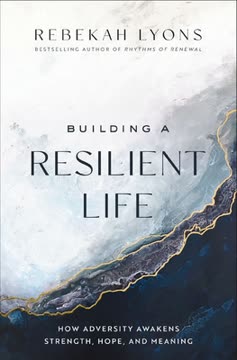
Key Takeaways
1. Acknowledge Ambiguous Loss to Understand Your Pain
We were losing our son, and this was the kind of loss I’d never experienced.
Unseen burdens. Life inevitably brings painful challenges, but some losses are harder to name and process. These are "ambiguous losses," characterized by a lack of clarity or resolution, leaving us feeling incompetent and eroding our sense of control. Author Rebekah Lyons experienced this with her son Cade's escalating behavioral issues, a gradual shift that felt like losing a part of him she couldn't identify.
Two types of ambiguous loss:
- Type One: Physical absence with psychological presence (e.g., a missing person, divorce, child moving away).
- Type Two: Psychological absence with physical presence (e.g., a loved one present but emotionally or cognitively altered by addiction, Alzheimer's, or mental illness).
Naming the unnameable. This type of grief, often illogical and chaotic, can last for years, surfacing sporadically. Recognizing and naming these covert losses—whether it's a fading dream, a disrupted routine, or a strained relationship—is the crucial first step toward healing and building resilience. It allows us to move past the shame of not "bouncing back" and begin to address the true source of our overwhelm.
2. Vulnerability and Confession Are Antidotes to Shame
I’m afraid I cannot change.
Shame's silent grip. The author recounts a period of intense domestic hyper-vigilance during lockdown, leading to agitation and emotional spirals. This compulsion was a coping mechanism for deep-seated shame, whispering, "There is something inherently wrong with you." Shame makes us feel trapped, powerless, and isolated, often encoded in our earliest experiences of rejection.
Physiological response. Shame manifests physically—rapid heart rate, shallow breathing, shutting down in conflict. It disrupts coherent thought, floods memory with past failures, and constructs a bleak future narrative. The author realized her shame response was a deeply ingrained "muscle," constantly activated by the pressure to measure up.
Antidote is exposure. The turning point came with a raw confession to her husband: "I am broken." This act of vulnerability, coupled with grace, brought immediate relief and a physiological shift. Confession, both to God and trusted others, breaks the chains of shame, restoring relationships with Christ, community, and ourselves. It's a rhythm of healing that reveals God's strength in our weakness.
3. Shift Your Narrative by Preaching Truth to Yourself
I need to shift the narrative.
Mindset matters. Our internal narratives profoundly shape our understanding of ourselves, our past, and our future. These stories influence how we perceive and respond to every moment. In a world of competing external narratives, the stories we tell ourselves about our own lives are the most powerful.
A living sacrifice. The author shares the inspiring story of Bill Lokey, a marriage therapist diagnosed with metastatic bone cancer. When doctors gave him a grim prognosis, he realized he had shifted from "fighting to live" to "preparing to die." He chose to "preach to himself," embracing a new narrative: to continue being a "living sacrifice" for God, living each day with purpose and meaning, regardless of the inevitable end.
Renewing your mind. Romans 12:1-2 calls us to offer our bodies as a living sacrifice and be "transformed by the renewing of your mind." This isn't passive observation but actively trading limited thinking for God's comprehensive truth. Practical steps include:
- Auditing media inputs and news sources.
- Meditating on Scripture day and night.
- Consciously choosing grateful thoughts over negative ones.
This mental discipline builds resilience, making us like a tree planted by water, producing fruit even in drought.
4. Retrain Your Brain to Overcome Negative Thought Patterns
Our thoughts shape our perspective, our perspective shapes our attitude, and our attitude determines our outcomes.
Brain's incredible power. The human brain, a three-pound control center with billions of neurons, is incredibly malleable. While trauma can negatively impact it, neuroscience confirms that we can change how our brains process information, even in adulthood. We don't become what we dream; we become what we think.
Manipulation and agency. External forces—governments, marketers, social media—exploit our brain's susceptibility to fear and scarcity, manipulating our thoughts and behaviors. However, we can reclaim agency by consciously training our brains. The key is to recognize how thoughts drive physiological responses (like panic attacks) and then implement strategies to rewire those connections.
Practical rewiring strategies:
- Identify triggers: Understand what prompts negative emotions or behaviors.
- Confront lies with truth: Replace fearful thoughts with affirmations like "You are LOVED. You are SAFE."
- Regulated breathing: Calm the mind and body during stress.
- Mindful meditation/prayer: Focus attention away from fear and towards God's promises (e.g., Jim Cress's "EXIT" acrostic, Seth Haines's Orthodox prayer).
- Scripture memorization: Anchor the mind in truth (e.g., Kennedy's response to panic).
By consistently applying these strategies, we can build new neural pathways, transforming dysfunctional patterns into resilient mindsets.
5. Embrace Adversity and Treat Anxiety as a Guide
When we face our pain and discomfort, we experience less of it.
Anxiety as a friend. The author recounts a panic attack on a plane, triggered by claustrophobia and past trauma. Instead of running, she was forced to "meditate through it" as the panic rolled through her body. This experience revealed a profound truth: the attack itself isn't the bully; it's the fear and shame during the attack that makes us avoid circumstances.
Turning towards discomfort. Research supports this counterintuitive approach: facing pain and discomfort, rather than avoiding it, actually reduces its intensity and our resistance to it. Mindfulness practices, for instance, help individuals with chronic conditions experience less pain by changing their relationship to it.
The "Five Whys" technique. Anxiety, fear, and pain serve as barometers, nudging us to investigate what needs to change in our lives. The author used Sakichi Toyoda's "Five Whys" to uncover the root of her calendar-induced anxiety:
- Problem: Physical anxiety when looking at calendar.
- Why? Overschedule with little margin.
- Why? Need to accomplish things efficiently.
- Why? So much to do, not enough time.
- Why? Want to live a life of significance.
- Why? Believe my worth depends on it.
This process revealed a core identity issue, leading to a decision to cut back and embrace "50 percent Rebekah," alleviating anxiety.
6. Build Resilience Through Intentional Resistance Training
Comfort doesn’t provide the body the resistance we need to build resilience.
Optional decline. While biological decline accelerates around age fifty, studies suggest that 70% of aging effects are optional. We have a choice to counter this through diet and exercise, making our bodies more resilient. Playing it safe and avoiding resistance, though comfortable, paves the way for decline.
Resistance as an ally. Modern life often conditions us to avoid resistance, but it is essential for growth. Just as physical resistance training builds stronger muscles (e.g., Pierce's lockdown transformation, Dr. Thomas DeLorme's progressive loading), emotional and spiritual resistance training builds resilience. The apostle Paul used the analogy of strict training for athletes to illustrate the discipline needed for spiritual life (1 Corinthians 9:24-27).
Mind over body. Our minds are designed to control our bodies, not the other way around. When appetites lead, we succumb to instinct; when discipline leads, we achieve greater outcomes. Jesus's forty-day fast demonstrated spiritual resilience over bodily cravings. Gabe's health scare prompted him to take his physical health seriously, leading to a remarkable transformation through diet, exercise, and mental routines, making him healthier and stronger than ever.
7. Cultivate Incremental Growth to Rewire Your Brain
Two millimeters per day. That is the average growth of an injured neuron that is in the process of healing.
Healing the brain. Early childhood experiences, especially "fragmented, patternless caregiving" (like Joy's orphanage experience or the impact of addictive devices), can injure neurons and alter stress-response systems. However, the brain possesses neurogenesis (growing new neurons) and neuroplasticity (rewiring connections) throughout life, offering hope for healing and change.
New wiring for new habits. To overcome anxiety, depression, or fear, it's not enough to stop negative patterns; we must create new neural pathways. This involves intentional focus, new habits, rhythms, and mental images. The author's "Rhythms of Renewal" (Rest, Restore, Connect, Create) provide a framework for this:
- Input rhythms: Rest (fasting from media), Restore (exercising).
- Output rhythms: Connect (sharing a laugh), Create (recovering a talent).
This input-output flow fosters healing and wholeness.
Practice makes resilient. Consistent, predictable, and nurturing practices lead to incremental growth. Joy's reading program, with its rhythmic repetition and focused attention, not only developed her literacy skills but also deepened her attachment and confidence, helping to repair the effects of early trauma. This demonstrates that we are not victims of our earliest formation; we can grow, change, and heal through daily, intentional practice.
8. Find Meaning by Following Your Deepest Longings for Beauty
You have made us for yourself, and our heart is restless until it rests in you.
The restless heart. The author's experience of losing 20/20 vision coincided with a shift from seeing beauty to seeing lack, revealing a deep restlessness. Augustine's famous quote, "Our heart is restless until it rests in you," highlights humanity's chronic hunger for God's presence. When this longing is unmet, we fill the silence with noise, consumption, or adrenaline, avoiding deeper questions of meaning.
Echoes of the divine. N.T. Wright suggests our deep ache for justice, spirituality, relationships, and beauty are "echoes of a voice"—God himself, whispering his purpose for us and the world. Curt Thompson's insights into our deepest desires—to love and be loved, for justice, connection, meaningful work, healthy bodies/brains, adventure, and beauty—align with this primal call.
Beauty as antidote. "Beauty is the antidote to scarcity." When we fear, we see lack; when we recognize beauty, we encounter the divine. Cultivating beauty, whether through nature walks, playing music, or revisiting family history, aligns us with God's creative impulse. This intentional pursuit of beauty shifts our perspective, making us feel more loved, valued, and less restless, thereby strengthening our resilience against a "drab, dark, depressing world."
9. Design Flourishing Spaces and Make Good Things
The places we inhabit matter. They not only serve as the backdrop of our memories, they actually help form our memories and contribute to the Joy we experience daily.
Spaces for renewal. Our physical spaces profoundly impact our well-being. The author transformed her home by converting a gas fireplace to wood-burning, creating a "hygge" (Danish for cozy contentment) atmosphere. Intentional curation of furnishings, removal of high-tech distractions (like a phone-charging box), and prioritizing quality over quantity can turn a home into a "space of flourishing" that rejuvenates the soul.
Spaces for challenge. Resilience is also cultivated by engaging spaces that challenge us. Wilderness therapy programs, complicated hikes, or high-flying ropes courses push us out of comfort zones, building confidence and new mental/physical muscles. Choosing experiences that stretch us, rather than defaulting to ease, strengthens our grit.
Making good things. Viktor Frankl's "existential vacuum" and "Sunday neurosis" describe the distress of meaninglessness that arises from boredom and busyness. God's "cultural mandate" (Genesis 1:28, 3:23) calls us to be fruitful, multiply, subdue, and cultivate—to make good things. This creative impulse, hardwired into our DNA, fills us with purpose and strengthens resilience. Working with our hands (gardening, baking, carpentry) relieves stress, improves neuroplasticity, and connects us to a timeless sense of value, as seen in "durable trades."
10. Forge Resilient Community by Linking Arms and Building Small
Though she be but little, she is fierce.
Beyond isolation. The pandemic highlighted humanity's need for connection, exposing the dangers of increasing isolation. While mental health declined for many, communities that "linked arms, joined hearts" found strength. Gabe's men's Bible study, studying Revelation during lockdown, fostered a "fresh fire" and "resilient hope," leading to practical support and a shared mission.
The early church model. The book of Acts illustrates the power of a gathering church: devoted to Scripture, fellowship, breaking bread, and prayer. Despite persecution, their solidarity and mutual care led to growth and resilience. The author's "First Front Lawnist Church of Franklin" mirrored this, creating empowering gatherings and even hosting a wedding when venues were closed.
Small is strong. Our culture often equates "bigger is better" with strength, but history and Scripture (mustard seed, yeast parables) show that resilience often thrives in small, committed communities. Donald Kraybill's insights into the Amish reveal their strength comes from prioritizing community over individual, keeping groups small (20-40 families) to ensure deep, relational knowledge and mutual support. This intentional "living small" allows for significant impact and enduring resilience.
11. Harness the Power of "We" to Endure and Thrive Together
Resilient lives are not formed in isolation; resilient lives are forged in community.
Unified purpose. Jesus prayed for a unified community, reflecting the inherent interpersonal relationship within the Trinity (John 17:20-23). This prayer came to fruition in the early church and was re-experienced by the author's community during the pandemic. Women's Bible studies and community initiatives emerged, driven by a shared conviction to be the hands and feet of Christ.
Community as a lifeline. Research from the American Psychological Association and the CDC confirms that strong support systems and resilient communities are crucial for bouncing back from adversity. Historically, disasters often led to increased social solidarity, unselfishness, and strengthened mental health, demonstrating that "resilient people and communities are formed by difficult circumstances."
Beyond self-sufficiency. Individualism teaches self-sufficiency, but we are made to have our needs met in community. True, Christ-centered community reminds us of our identity, calls forth character, celebrates gifts, and provides belonging. It saved the author from burnout, transforming her marriage, parenting, and friendships. Resilience isn't found in the "power of me"; it's forged in the "power of we," creating unshakable systems for God's glory and bringing his love and light to a dark world.
Review Summary
Reviews for Building a Resilient Life are generally positive, averaging 4.07/5. Readers appreciate Lyons' vulnerability, practical framework, and integration of neuroscience with faith. The book's five rules—Name the Pain, Shift the Narrative, Embrace Adversity, Make Meaning, and Endure Together—resonated with many. Common criticisms include heavy pandemic references, feeling more like a self-help checklist than gospel-centered guidance, and oversimplifying complex struggles. Readers who engaged slowly and reflectively found greater value, while others felt the Christian content was insufficient compared to psychological material.
People Also Read