Ideas clave
1. Language Acquisition is an Innate, Staged Journey from Cries to Words
We shouldn’t be surprised that babies learn languages – and learn them so quickly. It’s what they’re designed to do.
Innate capacity. From birth, the human brain is primed for language, equipped with a "language acquisition device" that actively seeks and processes linguistic input. This innate readiness explains why babies, regardless of their cultural background, progress through universal stages of vocalization, demonstrating a natural drive to communicate. This process begins even before birth, as babies in the womb can hear and recognize their mother's voice, absorbing the rhythm and intonation of their future mother tongue.
Developmental stages. A baby's journey to language unfolds in predictable stages, starting with basic vocalizations that signal needs. These evolve into playful "cooing" around three months, followed by "babbling" from six to nine months, where they experiment with sounds like "ma-ma-ma" and "da-da-da." While these early sounds may resemble words, they lack meaning until around nine months, when babies begin to infuse their utterances with the rhythm and intonation of their native language, making them sound distinctly English, French, or Chinese.
First words and vocabulary growth. Around their first birthday, babies typically utter their first meaningful word, a magical moment for parents. This marks the transition from a passive vocabulary (understanding words) to an active one (using words). By 18 months, a child's active vocabulary can expand to about 50 words, growing at an astonishing rate of a new word every few days. This rapid acquisition demonstrates the brain's incredible efficiency in mapping sounds to meanings, laying the foundation for more complex linguistic development.
2. The Human Body is a Complex Instrument for Producing Diverse Sounds
Speech needs a stream of air to carry the sounds. And that airstream begins in our lungs.
Vocal organs at work. Speech production is a marvel of biological engineering, involving a coordinated effort from various vocal organs. The process begins with the lungs, which provide the necessary airstream. This air then passes through the vocal folds (often called vocal cords), two flaps of tissue in the throat that vibrate rapidly—hundreds of times per second—to create voiced sounds and control pitch. The Adam's apple, a protective cartilage, shields these delicate structures.
Shaping sounds in the mouth. As air moves from the vocal folds, it enters the mouth, where the tongue, lips, and jaw act as dynamic shapers, creating hundreds of distinct sounds. Tiny movements of these articulators can transform one sound into another, such as the subtle difference between a voiced [d] and a voiceless [t], both formed by pressing the tongue against the ridge behind the teeth. Mastering these precise movements takes years for children, as they learn to coordinate breath, vocal fold vibration, and oral articulation.
Consonants, vowels, and nasal sounds. English, for instance, utilizes over 40 distinct sounds, categorized into consonants (where airflow is blocked or partially obstructed by the tongue or lips) and vowels (where airflow is unobstructed). Further complexity arises with nasal sounds like [m] and [n], where the uvula (the soft tissue at the back of the throat) lowers to allow air to exit through the nose. Children often master sounds at the beginning and middle of words before those at the end, highlighting the intricate learning curve involved in phonological development.
3. Grammar and Vocabulary Form the Essential Structure of Meaning
Grammar is the way we make sense of words. Without grammar, there’s only vagueness.
Grammar as meaning-maker. While individual words carry meaning, it is grammar—the system of rules governing how words combine into sentences—that truly unlocks clarity and precision. Without grammar, words remain ambiguous; for example, "band" can mean a musical group, a strip of material, or a group of rebels. The surrounding grammatical structure of a sentence clarifies which meaning is intended, transforming isolated words into coherent thoughts.
Building sentences. Children instinctively grasp the power of combining words around 18 months, moving from single-word utterances like "gone" to two-word phrases such as "teddy gone" or "milk cup." This marks the beginning of their grammatical journey, where they learn to construct sentences that describe events, ask questions, and issue commands. By the time they enter school, most children have mastered hundreds of sentence patterns, enabling them to tell stories and engage in complex conversations.
Cross-linguistic grammatical diversity. Every language possesses its unique grammatical rules, which can differ significantly from English. For instance:
- Word Order: Welsh places the verb at the beginning of a sentence ("Is Sian in the kitchen"), while Hindi often places it at the end.
- Adjective Placement: English and German typically place adjectives before nouns ("a black cat"), whereas French and Welsh place them after ("un chat noir" - a cat black).
- Word Endings (Cases): Languages like Latin use word endings (cases) to signal a noun's function in a sentence, making word order less critical. For example, "canis vidit puerum" (the dog saw the boy) and "puer vidit canem" (the boy saw the dog) use different endings for "dog" and "boy" depending on who is performing or receiving the action.
4. Language is Inherently Dynamic, Constantly Evolving Across Time and Place
All living languages change. They have to. Languages have no existence apart from the people who use them.
Constant evolution. Language is a living entity, constantly adapting to the needs and experiences of its speakers. This inherent dynamism means that all living languages are in a perpetual state of change, with only dead languages remaining static. The rate of change varies across linguistic components, with vocabulary evolving rapidly, grammar more slowly, and writing systems being the most resistant to swift alteration.
Drivers of change. New inventions and cultural shifts are primary catalysts for lexical change, introducing hundreds of new words annually (e.g., "Google," "blogging," "credit crunch"). Conversely, old words, like "brougham" (a type of carriage) or "arrant knaves" (complete villains), gradually fall out of common use. Grammatical structures also evolve, as seen in the shift from Jane Austen's "Jenny and James are walked" to modern English's "Jenny and James walked." Pronunciation changes, such as the shift from "shed-youll" to "sked-youll" for "schedule," also occur over decades, often sparking initial resistance before becoming widely accepted.
Variations in writing and social impact. Even the seemingly rigid rules of writing—spelling, punctuation, and capitalization—undergo gradual transformations. For example, the 18th-century practice of capitalizing all nouns in English, similar to modern German, has largely disappeared. These linguistic shifts are not merely academic; they reflect and reinforce social distinctions. Accents and dialects, for instance, not only indicate geographic origin but also convey information about social class and education, as exemplified by the historical development of Received Pronunciation (RP) in Britain.
5. Writing Systems Evolved from Simple Marks to Sophisticated Alphabets
Deciding when human beings first started to write is quite tricky, because it’s a problem deciding whether the marks they made are drawings or part of a writing system.
From tallies to tokens. The origins of writing lie in humanity's need to record and track information, evolving from simple marks to complex systems. Early humans, around 30,000 BC, used "tally-sticks" and "tally-bones" to count things, making cuts to represent quantities. By 9000 BC, "clay tokens" emerged, shaped into balls or cones to represent specific items like sheep or cows. These tokens later acquired marks to distinguish types (e.g., male vs. female pigs), leading to the need for secure containers and external markings.
Cuneiform and logographs. The breakthrough came around 3400 BC with the development of cuneiform in ancient Uruk (modern Iraq). This system involved scratching wedge-shaped marks into clay tablets, initially pictorial but quickly simplifying and becoming more abstract. Cuneiform was the world's first true writing system, using signs that often represented whole words or concepts, known as logographs. Chinese characters, such as those for "house" or "person," are modern examples of logographs, where a single sign conveys an entire word.
The rise of syllabaries and alphabets. While logographic systems require memorizing thousands of signs, the desire for efficiency led to the development of syllabaries and alphabets. Syllabaries, like Japanese katakana, use signs to represent syllables (e.g., "su," "ta," "ru"). The most influential innovation was the alphabet, which assigns a single letter to each individual sound. Originating around 1800 BC in the Middle East, the North Semitic alphabet (ancestor of Hebrew and Arabic) and later the Greek and Roman alphabets, revolutionized writing by drastically reducing the number of symbols needed, making literacy more accessible and widespread.
6. Sign Languages are Rich, Complex Systems, Not Mere Gestures
Never think of deaf signing as if it were simply a set of primitive gestures. It’s as complex and useful and beautiful as any spoken or written language.
Beyond simple gestures. While hearing people use simple hand signals for basic meanings (e.g., thumbs up, waving), deaf sign languages are far more sophisticated. They are full-fledged languages, possessing thousands of signs that can be combined into complex sequences, mirroring the grammatical and expressive capabilities of spoken or written languages. Signers on television, for instance, translate spoken content at remarkable speed, demonstrating the depth and efficiency of these visual-manual systems.
Distinct linguistic structures. Deaf sign languages do not merely translate spoken words into signs; they have their own unique grammatical structures and semantic rules. For example, a sentence like "The boy who won the long jump has also won the high jump" would be signed conceptually, not word-for-word, and the sign order might differ from English. Furthermore, sign languages are not universal; just as spoken languages vary globally, so do sign languages. British Sign Language (BSL) and American Sign Language (ASL), for instance, are mutually unintelligible, highlighting their independent evolution and distinct linguistic identities.
Accents, dialects, and identity. Like spoken languages, sign languages exhibit regional variations, including dialects and accents. Deaf individuals from different parts of a country may use slightly different signs or articulate them with subtle variations that mark their origin. Finger-spelling, a system for spelling out words using hand shapes, provides a crucial tool for communicating names and unfamiliar terms, further underscoring the comprehensive nature of sign languages. These systems are vital for deaf communities, serving as powerful vehicles for communication, cultural expression, and personal identity.
7. Language is a Powerful Tool for Identity, Social Connection, and Persuasion
Your mother tongue forms part of your identity – your sense of who you are.
Identity and belonging. Language is intrinsically linked to identity, serving as a primary marker of who we are and where we come from. Accents and dialects immediately signal geographic and social origins, while the choice of a mother tongue deeply connects individuals to their cultural heritage. This profound link explains why people fiercely protect their languages, viewing linguistic repression as an attack on their very identity, as seen in historical struggles for language rights in places like Quebec or Wales.
Social bonding and etiquette. Beyond identity, language is fundamental to social interaction. Conversations, with their intricate rules of turn-taking and listener feedback, are the bedrock of human connection. Politeness, expressed through phrases like "please" and "thank you," or through indirect communication, helps navigate social situations and build rapport. Even seemingly trivial exchanges, like commenting on the weather, serve to fill awkward silences and reinforce social bonds, demonstrating language's role in maintaining harmonious relationships.
Rhetoric and influence. Language is also a potent instrument of persuasion, or rhetoric, used to influence thoughts and feelings. Words carry "connotations"—emotional associations—that can subtly bias a message, as seen in the contrasting terms "terrorists" versus "freedom fighters." Politicians, advertisers, and even everyday individuals employ rhetorical strategies, from carefully chosen vocabulary to rhythmic phrasing, to sway opinions and elicit desired actions. Understanding rhetoric is crucial for discerning manipulation and making informed decisions in a world saturated with persuasive language.
8. The Digital Revolution is Rapidly Reshaping Our Communication Styles
The computer has changed the nature of our language lives.
A new era of communication. The advent of computers and mobile phones has fundamentally transformed how we interact, introducing a vast array of electronic communication styles. From emails and chatrooms to blogs, social networks, and instant messaging, these platforms have created new linguistic norms. For younger generations, these digital communication methods are as natural as spoken language, learned almost instinctively, while older generations often experience them as akin to learning a new foreign language.
Instant messaging and textese. Instant messaging exemplifies the rapid evolution of digital language. Its emphasis on speed and brevity has led to unique conventions:
- Abbreviations: "u" for "you," "gr8" for "great," "lol" for "laughing out loud."
- Reduced formality: Lack of capitalization, minimal punctuation, and acceptance of minor typos.
- Emoticons: Visual cues like smileys to convey emotion, replacing verbal expressions.
- Chunking: Breaking sentences into short segments to facilitate quick, interleaved responses.
These features, while sometimes criticized as "bad English," are functional adaptations to the demands of instant digital interaction.
Platform-specific styles. The digital landscape fosters diverse linguistic styles, often dictated by platform constraints. Twitter, for instance, limits messages to 140 characters, necessitating extreme conciseness, while text messages allow up to 160. These limitations encourage creative abbreviation and concise phrasing, demonstrating that effective digital communication requires a nuanced understanding of each platform's unique linguistic demands. Paradoxically, mastering these abbreviated forms often requires a strong foundational knowledge of standard spelling and grammar.
9. Linguistics is the Scientific Study of Language, Offering Profound Insights and Practical Applications
The aim of linguistics is not to be fluent in lots of languages. It aims to discover how these languages work.
The science of language. Linguistics is the scientific discipline dedicated to understanding the fundamental nature of language itself, rather than merely learning multiple languages. Linguists investigate universal principles common to all languages, such as the structure of vocal organs or the cognitive processes of language acquisition, while also exploring the vast diversity in pronunciation, grammar, vocabulary, and social usage across the world's approximately 6,000 languages. This field seeks to answer ultimate questions about what defines human language and why languages differ.
Branches of linguistic inquiry. The study of language is multifaceted, encompassing various specialized branches:
- Phonetics: The study of speech sounds.
- Grammar: The study of sentence structure.
- Semantics: The study of meaning in language.
- Sociolinguistics: The study of language in relation to society (accents, dialects, social variation).
- Psycholinguistics: The study of language and the mind (acquisition, processing).
- Historical Linguistics (Philology): The study of language change over time.
These areas continually uncover new insights, even in well-studied languages like English, especially with the emergence of new communication forms like those found on the internet.
Applied linguistics in action. The scientific knowledge gleaned from linguistics has significant practical applications, forming the basis of "applied linguistics." This field uses linguistic insights to solve real-world problems, such as:
- Speech Therapy: Helping children with language delays by understanding normal language development and designing targeted interventions.
- Foreign Language Teaching: Developing effective methodologies based on how languages are learned.
- Lexicography: Informing the creation of dictionaries and thesauri.
- Forensic Linguistics: Analyzing language evidence in legal contexts.
- Language Planning: Guiding policies for language preservation and revitalization.
By applying scientific understanding, linguistics empowers professionals to address diverse linguistic challenges and improve human communication.
Resumen de reseñas
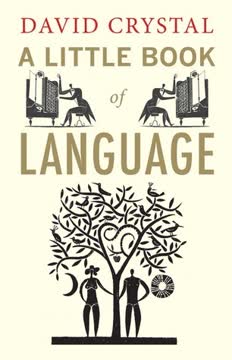
A Little Book of Language receives mixed reviews, averaging 3.75/5. Readers appreciate Crystal's enthusiastic, accessible writing style and broad coverage of linguistics topics, from child language acquisition to endangered languages. However, many note the book is better suited for beginners or younger audiences, with some experienced readers finding it overly simplistic or condescending. The book's focus on English examples occasionally limits its appeal to non-English speakers. Despite its brevity and introductory nature, most agree it effectively sparks interest in linguistics.
También leyeron